Ender’s Game by Orson Scott Card: Summary, Characters, Themes, and Ending Explained
First published in 1985, Ender’s Game by Orson Scott Card is a military science-fiction novel that explores far more than battles in space. At its center is Andrew “Ender” Wiggin, a gifted child selected for an intense training program designed to prepare humanity for another war against an alien species known as the Formics. Although the novel contains strategy, competition, and futuristic technology, its deepest conflicts are psychological and moral.
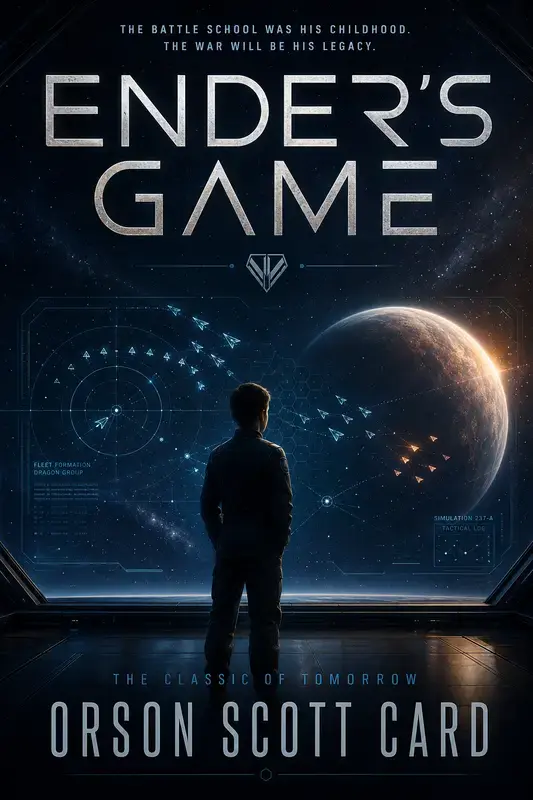
Ender is not simply trained to become a commander. He is isolated, manipulated, and repeatedly pushed beyond his emotional limits by adults who believe the survival of humanity depends on him. This makes the novel both a coming-of-age story and a troubling examination of how institutions can use talented individuals for larger political and military goals.
What gives Ender’s Game its lasting power is the tension between intelligence and compassion. Ender succeeds because he can understand his enemies, yet that same empathy makes violence more painful for him. Through his journey, the novel asks difficult questions about leadership, responsibility, manipulation, and whether victory can ever be separated from guilt.
Ender’s Game Summary and Plot Overview
Spoiler warning: The following section contains a complete summary of Ender’s Game, including major character deaths, the truth behind Ender’s final battles, and the novel’s ending.
Andrew “Ender” Wiggin is only six years old when the adults governing Earth decide that he may be humanity’s best hope for survival. Decades earlier, Earth was attacked twice by an alien species officially called the Formics, though most humans refer to them as “buggers.” The second invasion was stopped by the legendary commander Mazer Rackham, but military leaders believe another attack is inevitable. To prepare for it, the International Fleet searches for a child with the intelligence, adaptability, and strategic instincts needed to command humanity’s forces.
Ender is a “Third,” a rare third child born with government permission in a society that normally limits families to two children. His older siblings were also considered for military training. Peter is brilliant but dangerously cruel, while Valentine is compassionate but judged too gentle. The authorities hope Ender will possess Peter’s determination without his brutality and Valentine’s empathy without her weakness.
For years, Ender’s behavior is observed through a monitor attached to the back of his neck. When the monitor is removed, he believes the military has rejected him. Without its protection, he is confronted by a school bully named Stilson. Ender realizes that merely winning the immediate fight will not stop future attacks, so he defeats Stilson with overwhelming force, continuing even after the boy falls. Ender does not know that Stilson later dies from his injuries.
Colonel Hyrum Graff visits the Wiggin family and offers Ender a place at Battle School, an orbital military academy where gifted children are trained to become commanders. Ender understands that leaving means abandoning Valentine, the person he loves most, but Graff convinces him that humanity may need him. Ender accepts and is transported into space with other young recruits.
From the beginning, Graff deliberately isolates him. During the shuttle journey, he praises Ender in front of the other children, causing resentment and hostility. Graff believes Ender must learn to survive without relying too heavily on friendship or adult protection. Ender quickly recognizes the manipulation, but knowing that he is being controlled does not allow him to escape it.
At Battle School, Ender enters a competitive world built around military exercises, academic lessons, and psychological games. The most important activity takes place in the Battle Room, a zero-gravity arena where student armies fight mock battles using laser weapons that freeze an opponent’s suit. Ender understands the room differently from the other students. He realizes that in zero gravity there is no fixed direction, so he trains himself to think of the enemy’s gate as “down.” This simple change in perspective allows him to move and attack more effectively.
Ender initially struggles with loneliness, but he gradually forms friendships with students such as Alai, Shen, and Dink Meeker. He also spends time playing a computer game called the Fantasy Game, which seems to adapt itself to his private fears and emotions. One of its most disturbing challenges is the Giant’s Drink, in which a giant offers the player two drinks, both of which lead to death. Ender escapes by refusing to follow the expected rules and violently attacking the giant. The game’s images later become increasingly personal, incorporating figures resembling Peter and Valentine.
Before Ender has completed his basic training, he is promoted to the Salamander Army under the command of Bonzo Madrid. Bonzo resents receiving such a young and inexperienced soldier and orders Ender not to participate in battles. Ender continues practicing independently and receives additional instruction from Petra Arkanian, one of the school’s most capable soldiers. During a battle, Ender disobeys Bonzo’s command and acts at the last moment, helping the Salamander Army avoid defeat. Bonzo is furious, but Ender’s talent becomes impossible to ignore.
After serving in other armies and gaining more experience, Ender is promoted again—this time as commander of the newly formed Dragon Army. His soldiers are mostly inexperienced, and Ender suspects the teachers have deliberately given him a weak team. Instead of following traditional training methods, he divides the army into smaller, flexible groups called toons and teaches his soldiers to act independently. Among them is Bean, a younger child whose intelligence and unconventional thinking remind Ender of himself.
Dragon Army begins winning every battle. The teachers respond by making the conditions increasingly unfair. Ender’s army is forced to fight with little rest, face larger forces, and battle multiple armies at once. Each time, Ender adapts. He stops treating the exercises as ordinary competitions and searches for ways to achieve the official objective regardless of the expected rules. His victories make him respected by his soldiers, but they also leave him physically and emotionally exhausted.
As Ender’s reputation grows, Bonzo’s hatred becomes more dangerous. Bonzo eventually corners him in a bathroom with several other boys. Ender knows that he cannot merely escape; he believes he must defeat Bonzo so completely that there will never be another attack. He strikes Bonzo violently and leaves without realizing that the older boy has been fatally injured. As with Stilson, the adults conceal the truth from Ender because they fear guilt would destroy his ability to continue training.
Soon afterward, the teachers give Dragon Army another apparently impossible battle. Ender is so tired of being manipulated that he decides to win in a way that will make the game itself meaningless. Instead of focusing on defeating the opposing armies, he sends a small group directly through the enemy gate, completing the victory condition while most of his army is frozen. Ender believes that by exposing the absurdity of the exercise, he has rejected the teachers’ control. Instead, they immediately graduate him from Battle School.
Ender returns to Earth for a brief period before beginning advanced command training. By then, Valentine and Peter have become involved in global politics. Writing anonymously as Demosthenes and Locke, they publish political arguments online and gradually gain influence. Peter’s ultimate goal is power, while Valentine participates partly to restrain him. When Ender loses the desire to continue his military education, Graff brings Valentine to speak with him. Ender recognizes that the authorities are using his love for her, yet she still convinces him that refusing to fight could leave humanity defenseless.
Ender is taken to Command School on Eros, a former Formic base located inside an asteroid. There he meets Mazer Rackham, who explains how he defeated the Formics during the previous invasion. The Formics share a collective consciousness controlled by queens. Individual workers do not function as independent beings, so destroying a queen can disable an entire army. Rackham also reveals that after the second invasion, humanity launched a fleet toward the Formic home worlds. Because interstellar travel takes many years, the ships are already approaching their targets. Ender’s task is not to prepare for some distant future war; he must soon command the forces that already exist.
Ender begins a series of increasingly difficult simulated battles. He commands through a computer interface while trusted friends from Battle School—including Petra, Bean, Alai, Dink, and others—lead individual squadrons. Ender believes these exercises are preparing him for a final examination. The battles become relentless, and the pressure affects not only Ender but also his exhausted commanders. Nevertheless, he continues to win by sacrificing ships when necessary, exploiting enemy weaknesses, and refusing to become predictable.
For the final test, Ender faces a massive Formic fleet near their home planet. His own forces are greatly outnumbered, and the military officials observing him appear to expect failure. Ender is tired, angry, and determined to make the adults regret placing him in an impossible situation. He decides to repeat the logic he used in his final Battle School match: instead of trying to defeat every enemy ship, he will attack the central objective.
Ender orders his fleet to protect a small number of ships carrying the Molecular Disruption Device, commonly called the Little Doctor. The weapon creates a destructive chain reaction that causes nearby matter to break apart. His ships reach the planet and fire the device. The planet is destroyed, and the reaction spreads through the surrounding Formic fleet. Ender has apparently won the simulation by annihilating the enemy’s home world.
The observers around him erupt in celebration. Mazer then tells Ender the truth: none of the battles at Command School were simulations. Ender and his friends had been commanding real ships and real human crews through instantaneous communication technology. The people he sacrificed were real, and the planet he destroyed was the Formic homeworld. Humanity has won the war because Ender has exterminated almost the entire species.
The knowledge devastates him. The military leaders explain that they deceived him because they needed someone with his strategic brilliance but could not risk allowing compassion to limit his decisions. Ender was effective precisely because he believed he was playing a game. He never knowingly chose genocide, yet his actions caused it.
After the war, political conflict breaks out on Earth. Peter is becoming increasingly powerful, and Valentine fears that he will use Ender for his own ambitions. She joins the first group of human colonists traveling to one of the former Formic worlds and persuades Ender to accompany her. Ender eventually becomes the colony’s governor, but he remains troubled by what he has done.
While exploring the new world, Ender discovers a landscape that resembles locations from the Fantasy Game. He realizes that the Formics had observed his mind and used the game’s images to communicate with him. Hidden within this landscape, he finds the pupa of a surviving hive queen. Through a direct mental connection, the queen reveals that the Formics had not understood that individual humans possessed independent consciousness. During the first invasions, they believed that killing humans was no different from destroying the replaceable workers of their own species. Once they understood humanity’s nature, they no longer intended to attack Earth.
The Formics had attempted to communicate, but humanity’s fear and determination to survive made reconciliation impossible. Knowing that their destruction was approaching, they arranged for Ender to find the last queen so their species might someday begin again. Ender promises to search for a safe world where she can be released.
With the queen’s help, Ender writes a book titled The Hive Queen, telling the Formics’ story honestly and sympathetically. He later writes another book about Peter called The Hegemon. Publishing under the name “Speaker for the Dead,” Ender begins a new life devoted to understanding those who have died rather than judging them through fear or incomplete knowledge. He leaves the colony with Valentine and carries the hive queen with him, searching across the universe for a place where the species he destroyed can be restored.
Main Characters in Ender’s Game
Ender Wiggin
Andrew “Ender” Wiggin is the central character of the novel and one of the most gifted children ever observed by the International Fleet. From an early age, he demonstrates exceptional intelligence, strategic creativity, and an ability to understand how other people think. What separates him from his older brother Peter, however, is his compassion. Ender does not enjoy causing pain, even when he believes violence is necessary for his survival.
Ender’s greatest strength is also the source of his deepest suffering. To defeat an enemy, he must understand that enemy completely, including its fears, motivations, and weaknesses. This empathy allows him to become a brilliant commander, but it also prevents him from treating destruction as something simple or heroic. By the end of the novel, he is forced to confront the fact that the military used his compassion as a weapon, turning his understanding of the Formics into the means of their destruction.
Valentine Wiggin
Valentine is Ender’s older sister and the person he trusts most. She is intelligent, emotionally perceptive, and deeply compassionate. While Peter often represents the cruelty Ender fears within himself, Valentine represents the gentleness and humanity he wants to preserve. Her love gives Ender a reason to believe that he is not merely another version of Peter.
Although Valentine cares deeply for Ender, she is not entirely free from manipulation. Colonel Graff uses her influence to persuade Ender to continue his military training when he wants to stop. Valentine understands that she is being used, but she also believes that humanity may genuinely depend on her brother. Later, she protects Ender from Peter’s political ambitions by encouraging him to leave Earth. Her relationship with Ender remains one of the novel’s strongest emotional connections.
Peter Wiggin
Peter is Ender and Valentine’s older brother. Like Ender, he is highly intelligent and ambitious, but he lacks Ender’s empathy and self-restraint. As a child, Peter is physically and psychologically cruel, often threatening his siblings and taking pleasure in controlling them. Ender is terrified that his own capacity for violence means he is becoming like Peter.
Peter’s character becomes more complex as the story progresses. Working with Valentine under the online identities Locke and Demosthenes, he gradually gains political influence. His desire for power is genuine, but he also possesses the intelligence and discipline necessary to bring order to a divided world. Peter therefore represents one of the novel’s moral ambiguities: a person may be dangerous and selfish while still being capable of achieving stability and preventing greater conflict.
Colonel Hyrum Graff
Colonel Graff is one of the military officers responsible for selecting and training Ender. He recognizes Ender’s potential almost immediately and becomes convinced that the child may be humanity’s only chance of defeating the Formics. Graff sometimes appears protective of Ender, but he repeatedly places him under extreme pressure and deliberately isolates him from his friends.
Graff believes that Ender must learn to solve every problem without expecting adults to rescue him. For this reason, he allows bullying, unfair battles, exhaustion, and emotional manipulation to become part of Ender’s education. Although Graff understands the damage being done, he considers it justified by the threat facing humanity. His character embodies the novel’s central ethical conflict: whether the survival of millions can excuse the deliberate destruction of one child’s innocence.
Mazer Rackham
Mazer Rackham is the commander credited with saving humanity during the Second Formic War. His victory made him a legendary military figure, but the International Fleet secretly preserved him through relativistic space travel so that he could train the commander of the next war. When Ender reaches Command School, Mazer becomes his final teacher.
Mazer’s training is harsh, unpredictable, and designed to prevent Ender from becoming dependent on familiar patterns. He teaches Ender that an effective commander must understand both the enemy and the limitations of conventional strategy. Like Graff, Mazer participates in the deception that leads Ender to believe the real battles are simulations. He respects Ender’s intelligence, yet he is willing to sacrifice Ender’s emotional well-being because he believes victory is more important than honesty.
Petra Arkanian
Petra Arkanian is one of the most talented students at Battle School and one of the first people to treat Ender with genuine kindness. When Ender joins Salamander Army, Petra privately teaches him shooting techniques and helps him improve his abilities in the Battle Room. Her willingness to train him stands in direct contrast to Bonzo Madrid’s hostility and insecurity.
Later, Petra becomes one of Ender’s squadron leaders during the battles at Command School. She is intelligent, dependable, and courageous, but the constant pressure eventually overwhelms her. Her exhaustion reveals that even the strongest children have limits. Through Petra, the novel shows that military institutions do not simply develop talent; they may also consume the young people they depend upon.
Bean
Bean is a younger student assigned to Ender’s Dragon Army. He is exceptionally small, highly intelligent, and initially skeptical of Ender’s leadership. Ender sees similarities between Bean’s isolation and his own early experiences at Battle School. Rather than rejecting him, Ender gives Bean additional responsibilities and encourages him to think independently.
Bean becomes one of Ender’s most trusted soldiers and later serves as a squadron leader at Command School. His ability to recognize unusual possibilities makes him especially valuable during difficult battles. Bean also helps reveal Ender’s development as a leader. Instead of demanding blind obedience, Ender trains talented subordinates who can adapt, question assumptions, and act without waiting for detailed instructions.
Bonzo Madrid
Bonzo Madrid is the commander of the Salamander Army when Ender first joins an established Battle School team. Proud, disciplined, and deeply concerned with his authority, Bonzo sees Ender’s unusual talent as a threat rather than an advantage. He orders Ender to remain inactive during battles and becomes furious when Ender’s independent action helps the army avoid defeat.
Bonzo’s hostility eventually grows into a violent obsession. He confronts Ender in the bathroom, believing that defeating the younger boy will restore his pride. Ender responds with overwhelming force and unknowingly kills him. Bonzo’s fate demonstrates the destructive consequences of a culture built around competition, humiliation, and dominance. His conflict with Ender also reinforces Ender’s belief that every confrontation must be ended permanently, a lesson that later shapes his military decisions.
Alai
Alai is one of Ender’s earliest and closest friends at Battle School. Their friendship begins after Ender challenges divisions within their launch group and encourages the students to cooperate. Alai is confident, loyal, and capable, and his companionship gives Ender a rare sense of belonging within an environment designed to isolate him.
The friendship between Ender and Alai is especially important because it develops across cultural and religious differences without being defined by them. Before they are separated, Alai offers Ender a personal blessing, creating one of the novel’s most intimate moments. Later, he becomes one of Ender’s commanders at Command School. His presence reminds Ender that the people following his orders are not merely pieces in a strategic game, but individuals he knows and values.
Battle School, the Games, and the Making of a Commander
Battle School is more than a military academy. It is a carefully controlled environment designed to shape children into commanders by testing their intelligence, adaptability, and emotional endurance. Every part of Ender’s experience there serves a purpose, from his isolation among the other students to the increasingly unfair battles he is forced to fight. The school does not simply teach strategy. It studies how Ender reacts to pressure and gradually removes every source of security that might prevent him from becoming completely self-reliant.
The Battle Room is the central training ground. In this zero-gravity arena, student armies compete using weapons that freeze their opponents’ suits. Most students initially approach the room as if normal ideas of up, down, and direction still apply. Ender quickly realizes that these assumptions limit movement. By teaching himself to think of the enemy’s gate as “down,” he creates a stable point of orientation and gains a tactical advantage. This moment reveals one of his most important abilities: he does not merely become better at existing systems but questions the assumptions on which those systems are built.
When Ender is placed in command of Dragon Army, his leadership skills develop further. The army is made up largely of inexperienced soldiers, and the teachers expect Ender to struggle. Instead of relying on rigid formations, he divides his soldiers into smaller groups that can act independently. He trains them to make decisions rather than simply follow orders. This flexibility allows Dragon Army to respond quickly to unexpected situations and makes it difficult for opponents to predict its movements.
Ender’s success causes the teachers to increase the pressure. Dragon Army receives less rest, faces multiple armies, and is placed in battles where the rules appear deliberately unfair. These challenges are intended to push Ender beyond conventional thinking. He learns that the stated conditions of a game do not always define the true objective. In his final Battle School match, he ignores the opposing forces and sends soldiers directly through the enemy gate. By focusing on the victory condition rather than the expected method, he defeats a system designed to defeat him.
The Fantasy Game develops Ender in a different way. Unlike the Battle Room, which tests military strategy, the game examines his subconscious fears and emotional conflicts. The Giant’s Drink presents him with a challenge that seems impossible to solve fairly. Ender escapes only by attacking the giant instead of choosing between the offered options. This solution troubles him because it resembles the violent methods he uses against Stilson and Bonzo. Once again, he wins by refusing the rules, but victory leaves him uncertain about what kind of person he is becoming.
The game later creates images connected to Peter, Valentine, and Ender’s private memories. It becomes a psychological mirror, revealing the parts of himself that he cannot openly discuss. Unknown to him, it also becomes a means through which the Formics attempt to understand and communicate with him. What appears to be a private computer game therefore connects Ender’s inner life to the larger conflict shaping humanity’s future.
Both the Battle Room and the Fantasy Game blur the boundary between play and reality. Ender is encouraged to treat conflict as a game because games allow him to act without fully confronting the consequences. This becomes crucial at Command School, where he believes he is participating in simulations while actually directing real battles. The adults understand that Ender’s compassion might prevent him from knowingly destroying an entire species, so they hide the truth and allow the logic of games to guide him toward genocide.
By the time his training is complete, Ender has become the commander the military wanted: creative, disciplined, independent, and capable of finding victory in impossible circumstances. Yet this achievement comes at a severe cost. Battle School develops his brilliance by exploiting his loneliness, fear, and need to protect others. It proves that exceptional leaders can be trained, but it also raises a darker question about how much of a child may be sacrificed to create one.
Main Themes and Ideas in Ender’s Game
Empathy as Both a Strength and a Weapon
Ender’s greatest ability is not simply his intelligence but his capacity to understand other people completely. He studies how his opponents think, identifies what they fear, and anticipates how they will react. This emotional insight makes him an extraordinary strategist because he can see a conflict from the enemy’s perspective rather than relying only on force or established tactics.
However, Ender’s empathy has a destructive side. Once he fully understands an opponent, he also knows exactly how to defeat that person. This pattern appears in his confrontations with Stilson and Bonzo, where he recognizes that a temporary victory will not protect him from future attacks. He therefore uses overwhelming violence to end the threat permanently, even though he does not understand the full consequences of his actions at the time.
The military exploits this same quality during the war against the Formics. Ender can destroy them because he understands them, but that understanding also makes their destruction unbearable once he learns the truth. The novel presents empathy as morally complex: it can create compassion and connection, yet it can also provide the knowledge needed to cause devastating harm.
The Morality of War and Preemptive Violence
The central military conflict in Ender’s Game is driven by fear of another Formic invasion. Humanity has already survived two attacks, so its leaders believe that waiting for a third would be dangerously irresponsible. They launch a fleet toward the Formic worlds and prepare Ender to command it, treating the destruction of the enemy as the only reliable form of protection.
This decision raises difficult questions about preemptive violence. The humans assume that the Formics remain an existential threat, but they have almost no meaningful communication with them. Only later does Ender discover that the Formics had misunderstood human individuality during the earlier invasions and no longer intended to attack Earth. Humanity’s final war is therefore based not only on survival but also on fear, incomplete knowledge, and an inability to imagine peaceful contact.
The novel does not offer a simple judgment on the military’s actions. From the human perspective, the danger appears real, and failure could mean extinction. At the same time, the destruction of an entire species cannot be presented as an uncomplicated victory. By revealing the Formics’ intentions after the war is over, the story forces readers to consider whether fear can justify violence when the enemy’s motives are not fully understood.
Childhood, Isolation, and Psychological Manipulation
Although Ender is treated as humanity’s future commander, he remains a child throughout most of the novel. The adults responsible for his education repeatedly ignore his emotional needs because they believe the survival of the species depends on his performance. They separate him from his family, isolate him from his classmates, and ensure that he never feels completely safe or supported.
Colonel Graff believes Ender must learn that no adult will rescue him. This lesson makes Ender independent, but it also exposes him to bullying, exhaustion, and extreme psychological pressure. The authorities observe his suffering and sometimes feel guilty about it, yet they continue because they view him primarily as a military resource. His intelligence does not protect him from exploitation; instead, it makes him more valuable to those controlling him.
The novel therefore questions whether a supposedly necessary goal can justify manipulating a child. Ender’s achievements are extraordinary, but they are created through loneliness, deception, and emotional harm. The military succeeds in producing the commander it needs, yet the cost is the destruction of Ender’s innocence and his ability to trust the adults around him.
Leadership, Intelligence, and Responsibility
Ender’s leadership differs from the authoritarian style represented by Bonzo Madrid. Bonzo expects obedience and protects his status through intimidation, while Ender earns loyalty by understanding the strengths of his soldiers. He gives his toon leaders freedom to make decisions, encourages experimentation, and creates a flexible army that can adapt without waiting for detailed instructions.
His approach shows that effective leadership is not based only on control. Ender studies the people under his command and gives them responsibilities suited to their abilities. Soldiers such as Bean, Petra, Alai, and Dink become valuable because Ender trusts them to think independently. He succeeds not by making himself the only intelligent person in the group, but by creating a structure in which others can use their intelligence effectively.
Yet leadership also brings moral responsibility. Ender’s orders result in real deaths, even though he believes he is participating in simulations. This creates one of the novel’s hardest questions: how responsible is a commander who acts without knowing the truth? Ender did not knowingly choose genocide, but he cannot emotionally separate himself from what his decisions caused. His guilt suggests that responsibility is not always limited to intention; it may also arise from the consequences of one’s actions.
Communication, Fear, and the Unknown
The war between humans and Formics develops partly because the two species cannot understand one another. The Formics possess a collective consciousness, while humans experience themselves as separate individuals. During the first invasions, the Formics do not initially realize that killing individual humans is morally different from losing replaceable workers within their own society.
Humanity, meanwhile, interprets the Formics entirely through the experience of invasion. Because communication appears impossible, the aliens become symbols of absolute danger rather than beings with motives, fears, and the capacity to change. The lack of dialogue allows each side to misunderstand the other, but only the Formics eventually recognize the nature of their mistake.
Ender’s discovery of the hive queen reveals that communication might have prevented the final destruction. The tragedy is not caused by cruelty alone but by incompatible forms of consciousness and the assumptions created by fear. Through this conflict, the novel suggests that the unknown becomes most dangerous when people decide it cannot be understood.
Identity and the Fear of Becoming Cruel
Ender is deeply afraid that he resembles Peter. Both brothers are intelligent, observant, and capable of calculated violence. Whenever Ender hurts someone, he worries that his compassion is only an illusion and that Peter’s cruelty also exists within him. This fear shapes his self-image throughout the novel.
The difference between them lies partly in motivation. Peter enjoys power and domination, while Ender uses violence because he believes it is necessary to prevent further harm. Nevertheless, the results can look disturbingly similar. Ender defeats Stilson and Bonzo so completely that both boys die, even though he does not intend to kill them. His fear of becoming Peter is therefore not irrational; it reflects his awareness that good intentions do not automatically make violent actions harmless.
By the end of the novel, Ender begins building an identity beyond the role others created for him. As the Speaker for the Dead, he seeks to understand lives honestly and completely rather than reducing people to heroes or villains. His decision to protect the hive queen becomes an attempt to prove that he is capable not only of destruction but also of restoration.
Victory, Guilt, and the Possibility of Redemption
Humanity celebrates Ender’s final battle as a complete victory. The Formic threat has been eliminated, Earth is safe, and Ender is praised as the commander who saved the species. For Ender, however, the victory feels like a moral catastrophe. Once he understands that the battles were real, he sees himself not as a hero but as the person responsible for genocide.
His guilt separates the novel from more conventional stories of military triumph. Winning does not erase the lives lost, nor does it make deception acceptable. The adults who controlled Ender can justify their choices by pointing to humanity’s survival, but Ender must live with consequences he was never allowed to choose knowingly.
The surviving hive queen offers the possibility of redemption, though not a way to undo the past. Ender cannot restore the destroyed worlds or bring back the dead, but he can preserve the Formics’ story and help their species begin again. His later mission suggests that redemption is not achieved by denying guilt. It begins with accepting responsibility, telling the truth, and attempting to repair what remains.
The Ending of Ender’s Game Explained
The ending of Ender’s Game changes the meaning of nearly everything that came before it. Throughout Command School, Ender believes that he is completing a series of increasingly difficult simulations. Exhausted by constant pressure and convinced that the adults have designed another impossible test, he approaches the final battle with anger rather than hope. His fleet is greatly outnumbered, and the Formic home planet appears almost impossible to reach. Instead of trying to preserve his forces, Ender decides to win in a way so extreme that the teachers will be forced to end the game.
He orders his ships to protect the Molecular Disruption Device long enough for it to be fired at the planet. The resulting chain reaction destroys the Formic home world and the surrounding enemy fleet. Ender believes he has found another unconventional solution to an unfair exercise, similar to the way he ignored the opposing armies and entered the enemy gate during his final Battle School match. Then the observers begin celebrating, and Mazer Rackham reveals the truth: the battles were never simulations. Ender has been commanding real ships, sacrificing real human pilots, and fighting an actual war.
This revelation is devastating because Ender never knowingly agreed to exterminate the Formics. The military leaders deliberately hid the truth because they understood that his empathy might prevent him from making the necessary decisions. They needed his strategic brilliance, but they also needed him to believe that failure and destruction existed only inside a game. By controlling what Ender knew, they removed his ability to make an informed moral choice.
The deception also complicates the question of responsibility. Ender gave the orders that destroyed the Formic species, but he did so without knowing that the consequences were real. Legally or logically, the military leaders appear more responsible because they designed the deception and knowingly carried out the war through him. Emotionally, however, Ender cannot separate himself from what happened. His guilt comes not from intention but from the knowledge that his mind and decisions became the instruments of genocide.
The ending becomes even more tragic when Ender later discovers the surviving hive queen. Through their mental connection, he learns that the Formics had misunderstood human nature during their earlier invasions. Because Formic workers were controlled by a shared consciousness, individual deaths did not have the same meaning within their society. They initially failed to understand that every human being possessed a separate mind and an irreplaceable identity. Once they recognized this difference, they no longer intended to continue the war.
This means that humanity destroyed the Formics after the original misunderstanding had already been recognized by the other side. Human leaders, unable to communicate with the enemy and unwilling to risk another invasion, acted on fear and incomplete information. Their victory saved Earth from a possible threat, but it also eliminated a species that may no longer have been hostile. The novel refuses to make the outcome either completely heroic or completely simple.
The hive queen’s survival gives Ender a purpose beyond guilt. She explains that the Formics used images from the Fantasy Game to guide him toward her hiding place. They had studied Ender and understood that, unlike many human leaders, he was capable of both defeating an enemy and mourning that enemy’s destruction. The queen places her future in his hands because she believes his compassion may eventually restore what his military talent helped destroy.
Ender’s decision to carry the hive queen across the universe transforms the direction of his life. He can no longer be only the commander who saved humanity. By writing The Hive Queen, he tells the Formics’ story from their perspective and allows humans to see them as more than monsters. As the Speaker for the Dead, he dedicates himself to understanding lives honestly, including their failures and contradictions.
The ending therefore offers redemption without erasing responsibility. Ender cannot reverse the destruction of the Formic worlds, but he can preserve their memory and protect their last chance for survival. His final mission is not to conquer another enemy but to find a home for one. In this way, the novel ends by replacing military victory with a more difficult goal: understanding, reconciliation, and restoration.
What Ender’s Game Ultimately Says About Victory and Humanity
Ender’s Game presents victory as something far more complicated than defeating an enemy. On the surface, Ender achieves the greatest military success in human history. He destroys the Formic homeworld, ends the threat of another invasion, and ensures humanity’s survival. Yet the novel refuses to treat this outcome as a simple triumph. The moment Ender learns what he has actually done, celebration becomes horror. His victory saves one species by nearly erasing another, forcing readers to question whether survival alone is enough to make an action morally right.
Ender is often described as a hero, but the novel also presents him as a victim and a weapon. He possesses the intelligence and strategic imagination needed to command the human fleet, but he is denied the knowledge required to make a genuine moral decision. The adults around him shape his environment, control the information he receives, and use his trust in games to make him act without understanding the consequences. Ender wins because he believes the final battle is not real. His success therefore belongs partly to him, but the responsibility for how his abilities are used belongs largely to the institutions that deceive him.
At the same time, Ender is not portrayed as entirely powerless. Throughout the novel, he makes difficult choices and sometimes uses extreme violence. He defeats Stilson and Bonzo so completely that they can never threaten him again. In military training, he learns to sacrifice soldiers, identify weaknesses, and ignore conventional rules when necessary. These qualities make him effective, but they also reveal the danger of a philosophy in which every conflict must be ended permanently. The methods that protect Ender as an individual eventually become the methods through which an entire species is destroyed.
The novel’s view of humanity is similarly conflicted. Humans are capable of courage, cooperation, sacrifice, and extraordinary creativity. The International Fleet unites people across national boundaries, while Ender’s soldiers learn to trust one another under impossible conditions. However, humanity is also driven by fear. Because the Formics cannot easily communicate with humans, they are treated as an incomprehensible and permanently hostile force. The possibility that they may have changed is considered less important than the risk that they may attack again.
This fear is understandable, but Ender’s Game shows how easily understandable fear can become destructive certainty. Human leaders believe they are protecting their species, yet they never fully know the intentions of the enemy they destroy. Their inability to communicate with the Formics allows military necessity to replace moral investigation. By the time Ender discovers that the Formics no longer intended to attack, there is almost no one left to forgive or understand.
Ender’s later transformation into the Speaker for the Dead offers an alternative to this pattern. Instead of judging people and species through simplified categories, he tries to tell their stories truthfully. He does not erase wrongdoing, but he places it within a fuller understanding of motive, fear, culture, and circumstance. This approach reflects one of the novel’s most important ideas: genuine understanding requires seeing others as more than enemies, heroes, or symbols.
Ultimately, Ender’s Game suggests that intelligence without moral freedom can be exploited, while victory without understanding can become tragedy. Ender saves humanity, but he cannot accept survival as the only measure of success. His decision to protect the hive queen shows that his greatest achievement may not be winning the war, but refusing to let destruction become the final chapter. The novel leaves readers with an unsettling question: if people understand their enemies only after defeating them, can their victory ever be complete?


Comments