I, Claudius by Robert Graves: Summary, Characters, Themes, and Historical Meaning
Robert Graves’s I, Claudius is one of the most compelling historical novels about ancient Rome because it presents imperial history not as a distant sequence of dates and rulers, but as a dangerous family drama full of suspicion, ambition, betrayal, and survival. The novel is written as the autobiography of Claudius, a physically awkward and underestimated member of the imperial family who observes the rise and corruption of the Roman Empire from within its most powerful household.
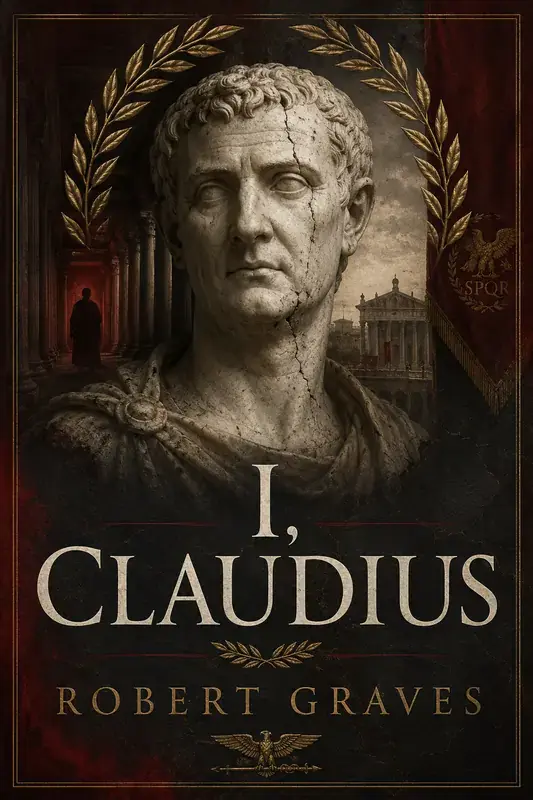
What makes the book especially fascinating is the contrast between Claudius’s apparent weakness and his sharp intelligence. Because others dismiss him as harmless, he is able to notice what more powerful figures miss. Through his eyes, readers see the reigns of Augustus, Tiberius, and Caligula as a world where public honor often hides private cruelty. I, Claudius remains worth reading because it combines political intrigue, historical detail, and psychological insight in a story that feels both ancient and surprisingly modern.
I, Claudius: Summary and Plot Overview
I, Claudius is presented as the private autobiography of Tiberius Claudius Drusus Nero Germanicus, later known simply as Claudius, the Roman emperor. At the beginning of the novel, Claudius explains that he is writing his life story honestly, without the official distortions that usually shape imperial history. This framing immediately gives the book its distinctive voice: Claudius is not only a character in the events he describes, but also a witness, interpreter, and survivor of one of the most dangerous families in Roman history.
The story begins before Claudius’s birth, with the rise of Augustus and the consolidation of power after the fall of the Roman Republic. Although Augustus presents himself as a restorer of Roman traditions, the old republican system has effectively been replaced by one-man rule. Around him stands the powerful Julio-Claudian family, where marriage, adoption, inheritance, and public reputation are all political tools. From the start, the novel shows that Roman politics is inseparable from family ambition. The question of who will inherit power becomes a source of constant intrigue, fear, and violence.
One of the central figures in the early part of the novel is Livia, Augustus’s wife and Claudius’s grandmother. Claudius portrays her as intelligent, disciplined, ruthless, and almost terrifyingly patient. Her main goal is to secure the succession for her own son, Tiberius, even when Augustus seems to favor other heirs. As various potential successors die or fall from favor, Claudius suggests that Livia is often behind these events. Whether every suspicion is provable or not, the effect is clear: the imperial household becomes a place where affection is uncertain, and survival depends on caution.
Claudius himself is born into this world as a disappointment to his family. He has a limp, a stammer, and various physical difficulties that make others treat him as foolish or embarrassing. His relatives often mock him, exclude him, or use him as a figure of ridicule. Yet this apparent weakness becomes his strange advantage. Because no one sees him as a serious political threat, he is allowed to remain alive while more admired, ambitious, or capable relatives are destroyed. Claudius grows into a sharp observer of people and events, learning to listen carefully while pretending, or allowing others to believe, that he understands very little.
A major emotional contrast in the novel comes through the figure of Germanicus, Claudius’s beloved brother. Germanicus is brave, honorable, popular with the army, and admired by the Roman people. To Claudius, he represents a better possibility for Rome: a leader who might combine military strength with justice and moderation. However, Germanicus’s popularity also makes him dangerous to those already in power. His career is marked by suspicion and rivalry, especially under Tiberius. When Germanicus dies under mysterious circumstances, Claudius and many others believe he has been poisoned. His death is one of the novel’s great turning points, because it removes one of the few figures who seems capable of resisting the moral decay of the imperial system.
After Augustus dies, Tiberius becomes emperor. His reign is shown as cold, suspicious, and increasingly oppressive. Tiberius is not presented as a simple monster; Graves gives him complexity, showing his bitterness, intelligence, and resentment at being manipulated into power. Yet as emperor, he becomes more isolated and cruel. Under his rule, Rome is dominated by fear, informers, treason trials, and political calculation. The rise of Sejanus, the ambitious commander of the Praetorian Guard, deepens this atmosphere of danger. Sejanus gains enormous influence over Tiberius and uses accusations, alliances, and executions to remove rivals. Once again, Claudius survives largely because others consider him too ridiculous to matter.
The next major phase of the story concerns Caligula, Germanicus’s son. At first, Caligula’s rise is welcomed by many Romans because he is the child of the beloved Germanicus. People hope that he will restore dignity and generosity after the harshness of Tiberius’s rule. Instead, Caligula becomes one of the most disturbing figures in the novel. His rule is marked by extravagance, humiliation, cruelty, and madness. He treats political power as a kind of divine performance, demanding worship and indulging in increasingly grotesque behavior. Claudius, who is both his uncle and a convenient object of mockery, remains close enough to observe the danger but powerless to stop it.
Caligula’s reign reveals one of the novel’s central ideas: when absolute power is placed in the hands of an unstable ruler, the entire state becomes vulnerable to his private fantasies. The Senate, the army, and the imperial family all adjust themselves around his whims, even when those whims become irrational or violent. Claudius’s survival during this period is almost accidental. He is humiliated, threatened, and manipulated, but he remains alive because Caligula does not see him as a rival.
Eventually, Caligula is assassinated by members of the Praetorian Guard and others who can no longer tolerate his rule. In the chaos that follows, Claudius hides, fearing that he too may be killed as a member of the imperial family. Instead, he is discovered by soldiers and unexpectedly proclaimed emperor. This moment is deeply ironic: the man who has spent his life being dismissed as useless is suddenly raised to the highest position in the Roman world. Claudius does not seize power through ambition; power finds him because every more obvious candidate has been removed by murder, suspicion, or political failure.
The novel ends with Claudius becoming emperor, which is both a surprising reversal and a darkly logical conclusion. His survival has depended on being underestimated, but that same survival now places him at the center of the system he has spent his life observing with fear and criticism. The ending does not present his rise as a simple triumph. Instead, it suggests that Roman history has trapped him. Claudius has lived long enough to tell the truth about the imperial family, but he has also become part of the very machinery of empire.
As a plot, I, Claudius is less about one hero’s rise than about the gradual corruption of a political order. Through Claudius’s memories, the reader sees how Rome’s public greatness is shadowed by private violence, how family loyalty is poisoned by ambition, and how survival often belongs not to the strongest, but to the person everyone else fails to notice.
Historical Context: Rome, Empire, and the Julio-Claudian Family
To understand I, Claudius, it is useful to know the political world behind the novel. Robert Graves sets the story during one of the most important transitions in Roman history: the shift from the Roman Republic to the Roman Empire. Although the book is a work of historical fiction, much of its power comes from the way it uses real people, real political tensions, and ancient historical sources to create a dramatic portrait of Rome’s ruling family.
Before the rise of Augustus, Rome had officially been a republic. In theory, power belonged to elected magistrates, the Senate, and the Roman people. In practice, however, the late Republic had been shaken by civil wars, military rivalries, social unrest, and the growing power of individual generals. Julius Caesar’s rise and assassination exposed the weakness of the old system. After Caesar’s death, another round of conflict followed, eventually leaving Octavian, Caesar’s adopted heir, as the dominant figure in Roman politics.
Octavian later became known as Augustus, the first Roman emperor. He was careful not to present himself as a king, because the Romans traditionally hated the idea of monarchy. Instead, he claimed to restore order, tradition, and republican government after years of chaos. This is one of the central political ironies behind I, Claudius. Rome still uses republican language, but real power has gathered around one man and one family. Titles, ceremonies, and public appearances disguise the fact that the Republic has effectively become an empire.
This hidden monarchy creates one of the novel’s main sources of tension: succession. In a traditional monarchy, the question of inheritance might be answered by a clear royal line. In Augustus’s Rome, the situation is more complicated. Since Augustus does not openly call himself a king, he cannot simply establish a royal dynasty in the old-fashioned way. Instead, succession is managed through adoption, marriage, public honors, military command, and family alliances. This makes the imperial household intensely political. Every birth, marriage, illness, death, and accusation can change the future of Rome.
The Julio-Claudian family itself was a powerful combination of two aristocratic lines: the Julian family, connected with Julius Caesar and Augustus, and the Claudian family, one of Rome’s oldest patrician houses. In the novel, this family connection is not just a matter of genealogy. It becomes a closed world of ambition, rivalry, loyalty, and fear. The private lives of Augustus, Livia, Tiberius, Germanicus, Caligula, and Claudius are never merely private. Their marriages and quarrels affect the entire empire.
Livia is especially important in this historical setting. As Augustus’s wife and Tiberius’s mother, she stands at the center of the succession problem. Graves presents her as one of the most powerful forces in Roman politics, even though she does not hold official imperial office in the way men do. Her influence works through marriage arrangements, family pressure, social authority, and secret manipulation. Whether every crime attributed to her in the novel is historically certain is less important than her symbolic role in the story. She represents the hidden power behind the public face of Roman government.
The reigns of Tiberius and Caligula also reflect deeper anxieties about imperial rule. Tiberius inherits a system built around Augustus’s personal authority, but he lacks Augustus’s public charm and political confidence. His rule becomes associated with suspicion, informers, treason trials, and withdrawal from public life. Caligula, by contrast, shows the danger of an emperor who treats power as limitless personal theater. Through these rulers, the novel explores a central historical question: what happens when a vast political system depends too heavily on the character of one individual?
Graves drew heavily on ancient historians, especially Suetonius and Tacitus, both of whom wrote vivid and often hostile accounts of the early emperors. These sources are full of scandal, rumor, moral judgment, and political drama. Graves uses them creatively, turning historical material into a first-person narrative told by Claudius himself. This gives the novel the feeling of a secret history, as if the reader is being allowed to hear what official Roman records concealed.
At the same time, I, Claudius should not be read as a neutral history textbook. Graves reshapes events, emphasizes certain interpretations, and gives psychological motives to historical figures whose inner lives cannot be known with certainty. His Claudius is both a historical character and a literary creation. The novel’s version of Rome is therefore a blend of documented events, ancient gossip, political analysis, and imaginative reconstruction.
This historical background matters because it explains why the novel feels so tense. The characters are not simply fighting for personal success; they are struggling within a political system that has no safe method of transferring power. The empire promises peace and stability after civil war, but inside the ruling family, that peace is maintained through fear, secrecy, and elimination. In I, Claudius, Rome’s greatness is real, but it is built on a dangerous contradiction: a republic that pretends not to be a monarchy, and a family that must destroy itself in order to rule.
Main Characters
Claudius
Claudius is the narrator and central figure of I, Claudius. At the beginning of the novel, he appears to be one of the least important members of the imperial family. He has a limp, a stammer, and other physical difficulties that make his relatives treat him with embarrassment or contempt. Many people assume he is foolish, weak, or politically useless. Yet this misunderstanding becomes the key to his survival.
Claudius is far more intelligent than others believe. He is observant, thoughtful, historically minded, and deeply aware of the corruption surrounding him. Because he is excluded from serious political life, he becomes a witness to it. He sees how power works inside the imperial household, how public virtue can hide private cruelty, and how ambition destroys even the most privileged people in Rome.
His greatest strength is not physical courage or political aggression, but endurance. He survives because he learns when to speak, when to stay silent, and when to let others underestimate him. By the end of the novel, his unexpected rise to emperor is both ironic and fitting: the man everyone dismissed has outlived almost everyone who seemed stronger.
Livia
Livia, the wife of Augustus and grandmother of Claudius, is one of the most powerful and frightening characters in the novel. Graves presents her as disciplined, intelligent, calculating, and completely devoted to securing power for her own bloodline. She does not rule openly, but her influence reaches into every corner of the imperial family.
Livia’s power comes from patience and control. She understands that in Rome, political victory often depends less on public speeches than on marriages, inheritances, rumors, and carefully timed deaths. In Claudius’s account, she is connected to many of the suspicious removals of possible heirs who stand in the way of Tiberius. Whether the reader accepts every accusation literally or not, Livia dominates the atmosphere of the novel.
She represents the hidden machinery of imperial politics. While Augustus appears as the public founder of a stable Roman order, Livia reveals the private cost of that order. Through her, the novel shows how family loyalty can become indistinguishable from political strategy.
Augustus
Augustus is the first emperor of Rome and one of the most important political figures in the background of the novel. He presents himself as the restorer of peace, tradition, and republican values after years of civil war. In public, he is careful, dignified, and fatherly. He wants Rome to see him not as a king, but as the guardian of Roman stability.
In the novel, however, Augustus is also a man surrounded by manipulation. He is powerful, but not all-seeing. He depends heavily on family arrangements to secure Rome’s future, and this makes him vulnerable to Livia’s influence. His desire to preserve the empire often blinds him to the moral decay inside his own household.
Graves does not portray Augustus as simply evil or foolish. Instead, he is a complicated ruler whose achievements are real but compromised. He brings order to Rome, yet the system he creates encourages secrecy, dynastic rivalry, and fear. His legacy is therefore deeply ambiguous.
Tiberius
Tiberius is Livia’s son and Augustus’s successor. He is one of the novel’s most psychologically complex characters. Unlike Augustus, he lacks warmth and public charm. He is intelligent and capable, especially as a soldier and administrator, but he is also bitter, suspicious, and emotionally damaged by years of family pressure and political manipulation.
Tiberius does not always seem eager for power, but once he becomes emperor, his rule grows increasingly dark. His reign is associated with treason trials, informers, cruelty, and withdrawal from public responsibility. He comes to see enemies everywhere, and this suspicion poisons Rome’s political life.
In I, Claudius, Tiberius shows how power can harden a person’s worst instincts. He is not merely a villain; he is also a product of the imperial system. Forced into roles he resents and surrounded by deceit, he becomes both victim and oppressor.
Germanicus
Germanicus, Claudius’s brother, is one of the noblest figures in the novel. He is brave, honorable, popular with the army, and loved by the Roman people. To Claudius, Germanicus represents what Rome might have become under a better kind of leadership. He combines military success with generosity, courage, and moral seriousness.
His popularity, however, makes him dangerous in the world of imperial politics. A man so admired cannot remain merely private; he becomes a potential rival, even if he does not seek power aggressively. His death under suspicious circumstances is one of the novel’s most painful moments.
Germanicus functions as a contrast to the corruption around him. He is not perfect, but he offers a vision of public virtue that the empire fails to protect. His fate shows that goodness alone is not enough to survive in a political world governed by fear and ambition.
Caligula
Caligula is the son of Germanicus and one of the most disturbing figures in I, Claudius. At first, many Romans welcomed his rise because they associated him with his beloved father. They hope he will bring renewal after the grim rule of Tiberius. Instead, his reign becomes a nightmare of cruelty, extravagance, and madness.
Graves portrays Caligula as a ruler who turns absolute power into personal performance. He humiliates senators, terrifies his family, demands divine honors, and treats Rome as though it exists to serve his fantasies. His behavior becomes increasingly irrational, but the political system around him continues to obey because he is the emperor.
Caligula’s character reveals the danger of unchecked power. His madness is personal, but its consequences are public. Through him, the novel shows how an empire can be held hostage by the mind of one man.
Messalina
Messalina becomes important later in Claudius’s life as his wife. In I, Claudius, her role is not as central as it becomes in the sequel, Claudius the God, but she still represents another stage in the dangerous connection between marriage and politics. Like many relationships in the imperial family, her marriage to Claudius is not simply personal; it is tied to status, influence, and survival.
Messalina is often associated with ambition, sensuality, and manipulation. Her presence reminds readers that Claudius’s rise does not free him from the traps of the imperial household. Even when he becomes emperor, he remains vulnerable to those closest to him.
As a character, Messalina also reinforces one of the novel’s recurring ideas: in imperial Rome, intimacy is never safe from politics. Husbands, wives, parents, and children are all drawn into the struggle for influence.
Sejanus
Sejanus is the commander of the Praetorian Guard under Tiberius and one of the most dangerous political climbers in the novel. Unlike members of the imperial family, he does not have dynastic legitimacy, but he understands how to gain power through proximity to the emperor. His influence grows as Tiberius becomes more suspicious and withdrawn.
Sejanus uses fear, accusation, and manipulation to remove rivals. He helps create an atmosphere in which no one feels safe, because any person can be accused of treason or disloyalty. His rise shows that imperial power does not belong only to emperors and heirs. Those who control access, information, and military force can become almost as powerful as the ruler himself.
His eventual fall is another example of the instability of Roman politics. In the world of I, Claudius, even the most successful schemer can quickly become a victim of the same system he used against others.
Main Themes and Ideas
Power and Corruption
One of the central themes of I, Claudius is the corrupting nature of political power. Robert Graves presents imperial Rome as a world where authority rarely remains clean for long. The Roman Empire promises order, peace, and stability after the violence of civil war, but the price of that stability is the concentration of power in one family. Once Rome depends on a single ruler, the character, fears, desires, and weaknesses of that ruler begin to affect the entire state.
The novel shows that power not only corrupts those who openly seek it. It also corrupts families, marriages, friendships, and public institutions. Augustus may begin with the intention of preserving Rome, but the system he builds creates dangerous competition over succession. Livia’s ambition for Tiberius turns the imperial household into a battlefield. Tiberius becomes increasingly suspicious and cruel once he is emperor. Caligula’s rule then shows the most extreme version of the problem: when a ruler’s power has almost no limits, his private madness becomes a public catastrophe.
Graves does not present corruption as a sudden change. Instead, it spreads gradually through compromise, fear, and silence. People excuse small injustices because they want security. They ignore suspicious deaths because they fear becoming the next victim. Senators flatter emperors they privately despise. Relatives pretend loyalty while plotting against one another. In this way, the novel suggests that corruption survives not only because of evil rulers but also because ordinary people and public institutions adapt themselves to tyranny.
Survival Through Weakness
Claudius’s survival is one of the most interesting ideas in the novel because it reverses the usual heroic pattern. He is not strong in the traditional Roman sense. He is not admired for military glory, physical beauty, public confidence, or political charisma. Because of his limp, stammer, and awkward manners, his relatives treat him as an embarrassment. Many assume he is stupid or useless. In a family obsessed with image, ambition, and succession, Claudius seems too insignificant to fear.
Yet this apparent weakness becomes his protection. Other members of the imperial family are killed, exiled, manipulated, or destroyed precisely because they are seen as important. Germanicus is loved too much. Postumus is a threat to succession. Agrippina is too proud and politically dangerous. Caligula is elevated because of his bloodline and popularity, only to become a monster of unchecked power. Claudius, by contrast, survives because no one believes he matters.
This theme gives the novel much of its irony. Claudius’s disabilities make him vulnerable to mockery, but they also allow him to observe events from the margins. He hears things others might not say in front of a respected political rival. He studies history, watches people, and learns how power operates. His weakness is not romanticized; he suffers because of it. But the novel shows that in a brutal political system, being underestimated can become a strange form of strength.
Family as a Political Battlefield
In I, Claudius, family life is never separate from politics. The imperial household is both a private family and the center of Roman power, which means that personal relationships are constantly shaped by public ambition. Marriage, adoption, inheritance, childbirth, and even illness become matters of state. A son is not only a son; he may be a future emperor. A wife is not only a wife; she may be a political ally, a spy, or a threat. A death in the family may alter the future of the empire.
This makes the novel’s family relationships unusually tense. Love exists, but it is rarely safe. Claudius loves Germanicus, and that bond gives the story some of its emotional warmth. Yet Germanicus’s popularity places him in danger. Augustus tries to manage his family for the sake of Rome, but by treating relatives as instruments of succession, he helps create resentment and rivalry. Livia’s devotion to her son Tiberius appears maternal on the surface, but it becomes inseparable from political calculation.
The result is a world in which intimacy is poisoned by suspicion. People cannot easily know whether affection is genuine or strategic. A family dinner may carry political meaning. A marriage may be arranged to solve one problem while creating another. Graves uses the imperial family to show how absolute power deforms the most basic human relationships. The closer a person is to the throne, the less private life remains.
Public Image Versus Private Reality
Another major theme in the novel is the contrast between appearance and truth. Roman political life depends heavily on public image. Emperors present themselves as guardians of tradition. Noble families display honor, dignity, and loyalty. Official ceremonies suggest unity and stability. Yet Claudius’s narrative repeatedly reveals the ugliness hidden behind these performances.
Augustus publicly represents moderation and restored republican values, but the political system beneath him is effectively a monarchy. Livia appears as a respectable Roman matron, yet Claudius describes her as a master of manipulation. Tiberius is officially the ruler of Rome, but his private bitterness and paranoia shape his reign. Caligula begins as the beloved son of Germanicus, a symbol of hope, before revealing himself as cruel, unstable, and obsessed with divine power.
Claudius himself also embodies this theme. His public image is that of a fool, but his private mind is intelligent and perceptive. He understands far more than others realize. This contrast makes him an ideal narrator, because he knows what it means to be misread. He lives in a society where appearances are often deliberately constructed, and his own life proves that surface impressions can be dangerously misleading.
Through this theme, Graves raises questions about history itself. Official history often preserves the public version of events, while private motives remain hidden. By presenting the novel as Claudius’s secret autobiography, Graves imagines a hidden record beneath the official one.
History, Truth, and Storytelling
Because I, Claudius is written as a fictional autobiography, it is deeply concerned with the problem of historical truth. Claudius claims to be telling the real story of his life and family, including the crimes, scandals, and motives that official accounts might suppress. This gives the novel the feeling of a confession or secret document. Readers are invited to believe that they are seeing Roman history from the inside.
At the same time, the novel reminds us that history is never completely simple. Claudius is intelligent and honest in many ways, but he is still a narrator with personal loyalties, resentments, fears, and limitations. He admires Germanicus, distrusts Livia, despises tyranny, and has his own emotional wounds. His version of events feels persuasive, but it is still a version. Graves uses this uncertainty to make the story richer rather than weaker.
The theme of storytelling also connects to Claudius’s identity as a historian. He is not merely remembering events; he is interpreting them. He wants patterns to be seen and lessons to be understood. His account suggests that history is shaped not only by battles and laws, but also by gossip, rumor, illness, marriage, personal weakness, and hidden ambition. In I, Claudius, history is both public record and private memory.
The Fragility of Republican Ideals
Although the novel takes place under the Roman Empire, the memory of the Republic remains important. Many characters still speak the language of republican virtue, tradition, law, and service to Rome. Augustus is especially careful to present his rule as a restoration rather than a monarchy. Yet the reality of power tells a different story. The Senate survives, but its independence is weakened. Public offices continue, but the emperor’s will dominates. Rome still honors liberty in theory while accepting autocracy in practice.
This contradiction is one of the novel’s most powerful political ideas. Graves shows that institutions can survive in name while losing their original meaning. The forms of the Republic remain, but the spirit of republican freedom has been compromised. People tolerate this because the empire brings peace after the civil war. Stability becomes more important than liberty, and many Romans accept the bargain even when they know it is dangerous.
Claudius understands this loss with particular sadness. He sees how easily people become accustomed to servility when it is dressed up as patriotism or necessity. The novel, therefore, asks a question that reaches beyond ancient Rome: how much freedom will a society surrender in exchange for order?
Fate, Chance, and Historical Irony
The rise of Claudius is one of the great ironies of the novel. Almost no one expects him to become emperor. He survives not because he is the most ambitious or powerful member of the family, but because he is overlooked. Many characters who seem destined for greatness die early, while Claudius, mocked and underestimated, remains alive. His life suggests that history is shaped not only by grand plans but also by accident, misunderstanding, and unintended consequences.
This theme gives the novel its dark humor. Livia, Tiberius, Sejanus, and others try to control the future through calculation, but their schemes often produce results they did not foresee. The imperial family attempts to secure succession, yet each attempt creates new instability. Caligula is elevated partly because of the love the Romans felt for Germanicus, but he becomes a disaster. Claudius is ignored because he seems harmless, and that neglect eventually makes him the last suitable survivor.
By the end of the novel, Claudius’s accession feels both accidental and inevitable. It is accidental because he never successfully plots his way to power. It is inevitable because the imperial system has consumed so many other candidates. Graves uses this irony to show that history is never fully under human control, even when powerful people believe they are directing it.
Claudius as Narrator: Intelligence, Irony, and Survival
One of the most distinctive features of I, Claudius is that the story is told through Claudius’s own voice. Robert Graves does not present him simply as a historical figure who later became emperor, but as a private witness to the violence, hypocrisy, and ambition of the Roman imperial family. This narrative choice gives the novel much of its power. Claudius is close enough to the center of events to understand them, but for most of his life, he is treated as too weak or foolish to influence them.
Claudius’s position is unusual because he lives both inside and outside power. By birth, he belongs to the ruling family. He knows Augustus, Livia, Tiberius, Germanicus, Caligula, and many other important figures not as distant public names, but as relatives. He sees their habits, fears, rivalries, and private conversations. At the same time, his physical disabilities and awkward public manner exclude him from serious political consideration. This makes him a perfect observer. He has access to the imperial household, but he is not regarded as a dangerous competitor.
His intelligence is therefore hidden in plain sight. Many people around Claudius mistake physical difficulty for mental weakness. Because he stammers, limps, and behaves awkwardly, they assume he lacks judgment. The cruelty of this assumption is one of the novel’s recurring points. Claudius is mocked, ignored, and underestimated by people who are often less perceptive than he is. Yet their contempt gives him an advantage. They speak freely around him, reveal their motives, and fail to guard themselves because they do not believe he is capable of understanding what he sees.
This creates much of the novel’s irony. The people who think they are clever often expose themselves to the person they dismiss as a fool. Claudius survives not because he dominates others, but because he learns how dangerous it is to appear important. In a family where talented, popular, or ambitious people are constantly at risk, insignificance becomes a form of protection. Germanicus is admired and therefore feared. Agrippina is proud and therefore targeted. Caligula is elevated and then destroyed. Claudius, meanwhile, remains alive because others do not take him seriously enough to remove him.
As narrator, Claudius also gives the novel a tone that combines bitterness, humor, and clear judgment. He is often painfully aware of how ridiculous he appears to others, but he is not ridiculous in his own mind. His self-awareness prevents the narration from becoming sentimental. He does not pretend that his suffering has made him noble in every respect, nor does he describe himself as a conventional hero. Instead, he presents himself as someone who has learned from humiliation. His weaknesses have trained him to observe, distrust appearances, and value truth over public performance.
Claudius’s interest in history is also essential to his role as narrator. He is not only telling his personal story; he is trying to correct the record. The novel is framed as a hidden autobiography, a version of events that challenges official history. This matters because the Roman world of the novel is built on public images. Emperors are praised as virtuous while committing cruelty. The Republic is said to survive while the monarchy quietly rules. Families display honor while plotting against one another. Claudius writes against these false surfaces. His narrative becomes an attempt to reveal what power tries to conceal.
At the same time, his voice is not completely neutral. This makes him more believable, not less. Claudius has loyalties and wounds. He loves Germanicus and sees him as a model of Roman virtue. He distrusts Livia and interprets much of the family’s suffering through her ambition. He despises tyranny, yet he eventually becomes emperor himself. These tensions make his narration complex. Readers are encouraged to trust his intelligence, but also to recognize that his account is shaped by memory, emotion, and personal experience.
The first-person form also allows Graves to make large historical events feel intimate. Instead of presenting Roman history as a grand sequence of emperors, wars, and laws, the novel shows history as Claudius experiences it: through rumors, family conversations, illnesses, marriages, banquets, accusations, and sudden deaths. This makes the political world feel immediate and human. The fate of the empire is not decided only in public institutions, but also in bedrooms, dining rooms, private letters, and whispered conversations.
Claudius’s irony becomes especially powerful because he understands the absurdity of power. He sees that Rome, which presents itself as disciplined and rational, is often governed by vanity, fear, superstition, lust, and resentment. He watches men who claim to defend tradition behave like slaves before emperors. He sees rulers who possess enormous authority become trapped by suspicion. He observes that survival in such a world often depends less on virtue than on timing, disguise, and luck.
His eventual rise to emperor is the final irony of his narrative role. The man who has spent his life watching power from the margins is suddenly placed at its center. This does not feel like a simple victory. Claudius has survived because he was underestimated, but becoming emperor means he can no longer remain safely invisible. The mask that protected him is removed. His intelligence, once hidden, is now exposed to the same dangerous system that destroyed so many before him.
Through Claudius as narrator, Graves gives I, Claudius its emotional and intellectual depth. The novel is not just about the crimes of emperors or the scandals of ancient Rome. It is about how a person sees clearly in a world built on deception, and how survival can depend on being misunderstood. Claudius’s voice turns history into testimony: wounded, ironic, observant, and deeply aware that the truth is often preserved by those whom power has failed to notice.
Writing Style, Legacy, and Why the Book Is Still Worth Reading
Robert Graves’s I, Claudius remains powerful because it combines the appeal of historical fiction with the pace and tension of political drama. The novel is based on ancient Roman history, but it does not feel like a dry reconstruction of the past. Graves turns imperial politics into a vivid human story, full of ambition, fear, family rivalry, betrayal, and irony. His style gives readers the sense that they are not simply learning about Rome from the outside, but listening to someone who lived through its most dangerous secrets.
One of the most effective features of the novel is its first-person voice. By presenting the book as Claudius’s autobiography, Graves creates a tone that is personal, reflective, and often sharply ironic. Claudius does not describe events with the distance of a modern historian. He writes as someone who has been mocked, ignored, frightened, and underestimated by the people around him. This gives the narrative emotional weight. The reader sees Roman history through the mind of a man who has suffered inside the system he describes.
The language of the novel is clear and controlled rather than overly decorative. Graves does not depend on long poetic passages or heavy description to create atmosphere. Instead, he builds the world through character, dialogue, political detail, and narrative momentum. The result is a book that feels intelligent without becoming inaccessible. Even readers who are not already familiar with Roman history can follow the story because the drama is rooted in recognizable human motives: jealousy, pride, fear, love, resentment, and the hunger for power.
Graves’s handling of historical material is also central to the novel’s lasting appeal. He draws on ancient sources, especially the scandal-filled accounts of early imperial Rome, but he reshapes them into a coherent and compelling story. The novel does not simply repeat history; it interprets it. Graves gives psychological depth to figures who might otherwise seem like names in a chronicle. Livia becomes more than a powerful empress; she becomes the embodiment of hidden political will. Tiberius becomes not just a grim ruler, but a damaged man shaped by resentment and manipulation. Caligula becomes a terrifying example of what happens when absolute authority meets instability.
The book’s legacy also rests on its unusual hero. Claudius is not a typical protagonist of historical fiction. He is not a warrior, conqueror, or charismatic statesman. For much of the novel, he is treated as an embarrassment by his own family. Yet this is exactly what makes him memorable. His intelligence is quiet, his strength is defensive, and his survival depends on patience rather than dominance. In a world obsessed with power, Claudius matters because he sees what power does to people.
This makes the novel feel surprisingly modern. Although it is set in ancient Rome, its concerns reach far beyond that period. I, Claudius explores how authoritarian systems protect themselves, how public language can disguise private corruption, and how institutions can lose their meaning while preserving their outward forms. The Rome of the novel still speaks of tradition, honor, and republican virtue, but much of that language has become political theater. Readers can recognize this tension in many later societies, which is one reason the book has not lost its relevance.
The novel is also still worth reading because it shows history as something intimate. Large political changes do not happen only through battles, speeches, and laws. They also happen through marriages, illnesses, rumors, inheritances, personal grudges, and private fears. Graves understands that the fate of an empire can depend on family relationships and individual weaknesses. This gives the book a rich sense of cause and consequence. Rome’s public history is inseparable from the emotional and moral failures of the people who rule it.
Another reason for the novel’s endurance is its moral complexity. Graves does not present Roman history as a simple struggle between good and evil. Some characters are clearly cruel or corrupt, but many are more complicated. Augustus brings order after the civil war, yet creates a system that breeds dynastic danger. Tiberius is capable and intelligent, yet becomes suspicious and oppressive. Claudius himself is perceptive and sympathetic, but he is not entirely free from the compromises of power. This complexity prevents the novel from feeling flat or predictable.
The book’s influence has also been strengthened by its place in popular historical imagination. For many readers, I, Claudius has shaped the way they imagine the early Roman Empire: not as a distant museum world, but as a living arena of political intrigue and psychological danger. Its portrayal of the Julio-Claudian family remains one of the most memorable fictional treatments of Roman imperial history.
Ultimately, I, Claudius is still worth reading because it offers more than historical entertainment. It is a novel about survival, truth, power, and the strange accidents that shape history. Its world is brutal, but its narrator gives it intelligence and humanity. Through Claudius’s eyes, the reader sees that the most important witness is not always the loudest, strongest, or most admired person in the room. Sometimes history is preserved by the person everyone else has dismissed.


Comments