Mrs Dalloway by Virginia Woolf: Summary, Characters, Key Moments & Review
Mrs Dalloway is one of the most delicate and at the same time daring novels about everyday life, which, as it turns out, is not ordinary at all. The story takes place in post-war London over the course of just one day, but that single day is enough to reveal an entire universe of human feelings, fears, and memories.
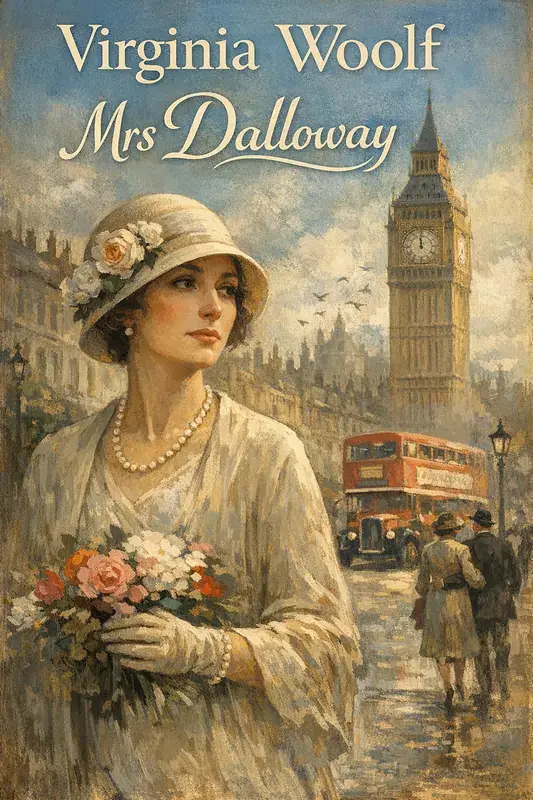
Virginia Woolf abandons a conventional linear plot and invites the reader to plunge into the stream of her characters’ consciousness. We seem to walk alongside Clarissa Dalloway through the city streets, hearing her inner voice, her anxieties that are both distinct and vague, flashes of memory, and quiet moments of joy. Through her gaze, and through the perceptions of other characters, an entire era gradually unfolds — a society after the First World War, with its hidden trauma, social changes, and fragile sense of normality.
Mrs Dalloway is a novel about time, about choice, and about how outwardly insignificant events can reflect profound upheavals in the soul. It is precisely this internal, almost intimate perspective that makes the book feel so vivid and so relevant even today.
Mrs Dalloway – Summary & Plot Overview
The plot unfolds in London over a single June day in 1923. Clarissa Dalloway, a middle-aged woman from the comfortable upper class, leaves the house in the morning to choose the flowers herself for the party she is hosting that evening. From this simple, almost everyday episode begins a complex inner journey, stitched together from memories, associations, and sudden thoughts.
As Clarissa walks through the city, her mind keeps circling back to the past. She remembers her youth spent at the country estate of Bourton, when many paths lay open before her, and nothing had yet been decided for good. Back then, there was Peter Walsh — passionate, restless, unpredictable, a man who loved her and offered a completely different kind of life, full of risk, conflict, and intense emotion. In the end, Clarissa married the calmer and more reliable Richard Dalloway, a cautious politician, choosing stability and social standing over a storm of feeling.
The present of the novel is constantly interwoven with the past. Memories of Sally Seton, her friend from youth, with whom she shared an especially deep, almost romantic attachment, force Clarissa to re-evaluate her choices. Her life appears orderly and prosperous, but behind this outward neatness lies a sense of having lost something essential — the freedom of youth, the courage to be different, to refuse to conform to society’s expectations.
Running parallel to Clarissa’s storyline is the story of Septimus Warren Smith, a veteran of the First World War. He lives in the same city and walks the same streets on the same day, but his inner world is radically different. Septimus suffers from severe psychological trauma: he is haunted by visions, by memories of a friend who died in the war; it seems to him that the world has lost all meaning and that the people around him are nothing but empty masks. His wife Rezia is tormented by her own helplessness: she loves her husband but cannot reach him, while the doctors they turn to either do not understand or underestimate the depth of his suffering.
These two storylines do not intersect directly for a long time, but they constantly echo one another. Where Clarissa secretly feels the fragility of life and a fear of ageing and death, Septimus is pushed to the extreme — he can no longer reconcile himself with reality and seeks an escape in an act of desperation. London in the novel becomes a shared stage on which all the characters move towards one another, not always realising how closely their paths pass.
During the day, Clarissa continues her preparations for the evening, and along with them, the stream of her inner reflections flows on. She thinks about her marriage, about her daughter Elizabeth, about how they have grown distant and how hard it has become to talk about anything that truly matters. The sudden appearance of Peter Walsh, who drops in to visit her after a long separation, stirs up a storm of feelings — shame, tenderness, irritation, nostalgia. Their brief conversation is full of things left unsaid: both of them know they could have lived a completely different life, but now all they can do is carefully brush against this unasked question.
In the evening comes the climax of the outer action — the long-awaited party at the Dalloways’ house. London society gathers: acquaintances, relatives, people from political circles. As hostess, Clarissa is constantly on the move, greeting guests and making sure everything goes according to plan. Outwardly, she is completely absorbed in her social duties, but inside, she continues to analyse every moment, trying to understand whether she has managed to create that special atmosphere that made the whole evening worth organising in the first place.
At the same time, Septimus’s fate comes to a tragic end. Unable to bear the pressure from the doctor who is about to send him to a mental institution, he takes his own life. This episode is not shown to Clarissa directly, but echoes of it reach her at the party through guests’ conversations. She learns that somewhere in the city, a young man has thrown himself out of a window to escape the interference of doctors and society.
The news of a stranger’s death shakes Clarissa deeply. For a moment, she withdraws to another room to be alone and tries to make sense of what she has heard. In this act, in this despair, she sees not only destruction but also a strange form of asserting one’s own freedom: a refusal to submit to what society imposes. Septimus’s death becomes a mirror in which her own fears are reflected, along with her attempts to hold on to the meaning of life in small things, in the fleeting beauty of the moment.
The ending of the novel is outwardly very quiet. The party goes on, guests chat, music rings out, and London continues its usual nocturnal life. But for Clarissa, this day becomes an inner point of convergence: she relives her youth and her choices, looks death in the face, and still whispers a soft “yes” to life — to life as it is, with all its fragility and imperfection. It is in this combination of external unobtrusiveness and inner intensity that the distinctive structure of Mrs Dalloway’s plot lies.
Major characters
Clarissa Dalloway
Clarissa is the hostess around whom the entire novel is built. Outwardly, she is the perfect upper-class lady, busy preparing for her party, concerned with the impression her guests will have and with making sure everything goes “as it should.” But her inner life is much more complex and profound: her thoughts constantly return to her youth, to the choices she never made, to the question of whether she has lived her life the right way.
She is acutely aware of the passage of time, the approach of old age, and the vulnerability of human existence. At the same time, Clarissa has a rare ability to notice beauty in small things — in a ray of sunshine, in the sound of a bell, in a glance from a passerby. Her subtle, sensitive yet unbroken nature makes her both fragile and strong, and her “yes” to life at the end of the novel is very quiet, but deeply convincing.
Richard Dalloway
Richard is Clarissa’s husband, a sensible, kind, and somewhat reserved politician. He is used to playing by the rules and values stability and social order. Unlike Peter Walsh, Richard is not prone to dramatic displays of emotion and does not speak loudly about his feelings, even when they are strong.
Through him, Woolf shows the side of a calm, “proper” life: honest work, duty, responsibility. Yet it is this restraint that creates a certain emotional vacuum in the marriage. Richard sincerely loves Clarissa, but finds it difficult to express this in words, and between them there remains a space of things unsaid — a space Clarissa fills with her doubts and her memories of the past.
Elizabeth Dalloway
Elizabeth is the daughter of Clarissa and Richard, a young girl standing on the threshold of adult life. The conventions of the older generation are less visible in her: she is searching for herself and has not yet decided how she wants to live or what she wants to do. Elizabeth moves away from the social masks so familiar to her mother and is drawn toward a more serious, “real” world.
Her relationship with her mother is complicated and somewhat cool; there is a clear distance between them. Clarissa sees in her daughter both a continuation of herself and a kind of challenge — another possible version of a woman’s fate, less dependent on social expectations. Elizabeth’s character brings into the novel the theme of generational change and the question of whether anything will truly be different in the future.
Peter Walsh
Peter is one of the most contradictory characters in the book. Once, he was in love with Clarissa and asked her to marry him, but she turned him down. He returns to London with the baggage of a not very successful personal life, a lingering sense of incompleteness, and a habit of painfully overthinking everything that happens.
Peter is impulsive, jealous, vulnerable, yet at the same time not without charm and vitality. His presence in the novel always stirs up old feelings and makes Clarissa wonder: what would have happened if she had chosen him instead of Richard? Through Peter, Woolf shows an alternative path — more turbulent, less stable, but perhaps richer emotionally.
Sally Seton / Lady Rosseter
Sally is Clarissa’s friend from her youth, one of the most vivid figures in her memories. As a young woman, she was bold, independent, and a bit rebellious: she broke conventions, said what she thought, and seemed to embody freedom itself. In her relationship with Sally, Clarissa experienced for the first time a feeling that went beyond ordinary friendship and came close to being in love.
Later, Sally becomes Lady Rosseter, a perfectly respectable wife with children and a solid place in society. But in Clarissa’s memory, she remains a symbol of youthful daring and the possibility of living differently — by one’s own rules. Their meeting in later life shows how time can smooth even the brightest personalities, yet still leave an indelible mark on the soul.
Septimus Warren Smith
Septimus is a war veteran, a man with severe psychological trauma through whom Woolf brings out the theme of post-war despair and invisible pain. He is young, intelligent, sensitive; he once loved literature and believed in lofty ideals, but the war has destroyed his inner world.
Now he is haunted by hallucinations, voices, and memories of a dead friend. He sees the people around him as soulless participants in a strange performance and cannot accept a return to “normal” life. Septimus becomes a tragic mirror of a society that prefers not to notice those who do not fit into its picture of prosperity. His fate is one of the most powerful and terrifying elements of the novel.
Lucrezia (Rezia) Warren Smith
Rezia is a young Italian woman, the wife of Septimus, who finds herself beside a man she loves but can rarely truly understand. For her, London is a foreign city, and English customs are cold and incomprehensible. She once dreamed of a simple family life, of children and quiet happiness, but instead she has found herself in a daily struggle for her husband’s soul.
Rezia’s portrait is tragic in its helplessness: she is caught between a cynical mental health system and Septimus’s despair. Her attempts to “bring him back to life” are shattered by the doctors’ lack of understanding and by society’s inability to take another person’s pain seriously. Through her, Woolf shows how mental illness destroys not only the person who suffers from it, but also everyone who stands close by.
Sir William Bradshaw
Sir William is a renowned psychiatrist, a symbol of the power of the system and of “normality.” At first glance, he is successful, self-assured, and respected. But there is a great deal of cold cruelty in his approach to patients: he tends to bend them to his will, to decide for them what is best, and to isolate those who do not fit within the accepted boundaries.
For Septimus, the meeting with Sir William becomes one of the decisive moments of his story. In the figure of the doctor, Woolf criticises not only a particular type of medicine, but also a broader social mechanism of repression — when the mask of health concern conceals a desire to control and remove those who are “inconvenient.”
Hugh Whitbread
Hugh is an old acquaintance of Clarissa and Richard, a typical representative of the respectable middle tier of English society. He cares about propriety, career, the right connections, and always looks impeccable. Peter Walsh is rather contemptuous of him, considering him shallow and self-satisfied.
Hugh is neither a villain nor a hero. He is more an embodiment of comfortable mediocrity that clings to outward polish and stability. His presence highlights the social environment in which Clarissa lives and helps to show that, in this world, form is valued more highly than substance.
Miss Kilman
Miss Kilman is Elizabeth’s governess and tutor, a woman with a hard life and a deep inner sense of resentment. She is poor, deeply religious, painfully aware of social injustice, and in some ways envies people like Clarissa, who have money and status.
There is a hidden tension between Miss Kilman and Clarissa: they rarely clash directly, but each feels the other as a threat. For Clarissa, Miss Kilman is a reminder that her world is far removed from those who live in deprivation. For the governess herself, Clarissa is a symbol of an unjust privileged class. Running through this conflict is the theme of class division and the spiritual emptiness that can lurk behind material well-being.
Lady Bruton
Lady Bruton is a representative of the old aristocracy, an active, authoritative woman who takes an interest in politics and public affairs. She hosts luncheons, discusses colonial issues, and is surrounded by male politicians whose opinions she values, while she herself remains in a secondary role.
In her portrayal, we see how even strong, intelligent women of that time were forced to act within the narrow confines allotted to them by society. Lady Bruton has influence and connections, but her voice is still heard only indirectly, through men. Next to Clarissa, she appears more “active,” but not more free, and this adds yet another nuance to the broader picture of a woman’s place in post-war England.
Key Moments & Memorable Scenes
One of the most memorable scenes in the novel is Clarissa’s morning trip to buy flowers. At first glance, it’s a trifle, a simple visit to a shop, but Woolf turns it into a moment when the world awakens. London seems to be only just coming together: the streets fill with people, cars, smells, and Clarissa experiences all of it with an almost physical sharpness. It is here that her ability to dissolve into the city is felt most clearly, to feel joy in the simple fact of existence, despite her anxiety and awareness of her own fragility.
Almost immediately, against this backdrop comes the episode with the airplane tracing an advertisement in the sky. People in the street lift their heads, trying to make out the letters; for a brief moment, each of them is pulled out of their inner isolation. This scene brings disparate characters together in a single gesture — everyone looks up. At the same time, the plane, filling the sky with letters that may seem meaningless to someone, serves as a reminder of how the modern world turns human attention into an object of manipulation, even when it is a matter of a beautiful summer sky.
The repeated chimes of Big Ben also become an important “character” in the novel. Every time the clock strikes the hour, the reader feels how time literally slices the day into pieces. For Clarissa, it is a reminder that the day is moving towards evening, life towards old age, and that everything that has happened and is yet to happen must fit into a limited span. The ticking of time becomes the background to all events, even the most intimate ones.
A special place in the novel is taken by the scene of Peter Walsh’s visit to Clarissa. Their conversation is full of awkwardness, broken phrases, pauses, and hidden agitation. Peter peers at her, trying to understand whether this is the same girl from Bourton, while Clarissa, smiling and observing the rules of propriety, inwardly returns to the moment when she said “no” to him. For a second, the tension between them becomes so strong that it seems just one more word — and the past will be rewritten. But that word is never spoken, and the scene dissolves, leaving behind a faint ache.
No less powerful are the episodes connected with Septimus. His walks in the park with Rezia, his sudden visions, his conversations with the doctors — these are scenes in which the world seems to split in two. To passers-by, he is merely a strange young man; to Rezia, a sick husband who must be “brought back to normal”; but for Septimus himself, the world has already crossed a line, and there is no way back. The meeting with Sir William Bradshaw is especially terrifying in its outward respectability: beneath the mask of care lies a sentence — adapt or be isolated.
The climax of Septimus’s inner story is the scene of his suicide. Woolf does not dwell on graphic detail, but the tension and tragedy of the moment are felt with piercing sharpness. His leap from the window is a desperate way to preserve himself, if only in this final act of choice. Later, when Clarissa hears about it at her party, another quiet yet pivotal scene arises: she is left alone with her thoughts and tries to imagine this stranger. In his death, she sees a terrible but honest “no” to a world that breaks people, and at the same time, she feels her own soft “yes” to life even more intensely.
Finally, the evening party brings together all the novel’s threads. In the large house, almost the whole of Clarissa’s social world gathers — from old friends to high-ranking guests. On the surface, it is just a social event, but for Clarissa herself, every guest, every glance, every movement becomes a test of her choices, of her role as hostess, wife, and woman who once chose order over the storm. There are no grand gestures in the final scenes, but there is a sense of an inner resolution: the heroine acknowledges both her vulnerability and her ability to find meaning in the fleeting beauty of the moment. It is in such quiet, seemingly inconspicuous episodes that the novel’s true power lies.
Why You Should Read “Mrs. Dalloway”?
Mrs Dalloway is a novel that is easy to underestimate if you judge it by its outer plot. It seems that almost nothing happens in the book: one woman is preparing a party, another person somewhere in the city is suffering and moving towards a tragic end, and London goes about its ordinary day. But it is precisely in this outward simplicity that an astonishing depth is hidden. The book offers not so much a story as an experience of seeing the world from inside a person, with all their doubts, memories, stray associations, and secret fears.
As you read the novel, you gradually begin to notice how Virginia Woolf can transform the smallest details into something meaningful. A glance at a shop window, a word thrown out in passing, a flash of memory about a long-ago summer — all of this becomes a reason to reflect on life as a whole. In this sense, Mrs Dalloway encourages us to look more closely at our own everyday lives: suddenly it turns out that our days, too, are made not only of tasks and obligations, but of subtle inner movements that usually remain unnamed.
Another important reason to turn to this novel is its honest conversation about trauma, loneliness, and mental health long before these topics became widely discussed. The story of Septimus Warren Smith sounds very modern even today: a person whom “normal” society does not listen to, does not understand, and tries simply to push aside because his pain is inconvenient and frightening. Through him, Woolf shows where indifference to another person’s inner world can lead, and this makes the book especially relevant to our own time, when the themes of empathy and support are felt ever more acutely.
The novel’s specifically female dimension is no less important. Clarissa Dalloway lives in a world where a woman, even one who is well-off and respected, remains in the shadow of general rules. Her path is a constant balancing act between society’s expectations and her own sense of self. Woolf doesn’t turn Clarissa into the heroine of a manifesto, but she shows with great precision how subtle and unobtrusive the confines are that women of her circle are placed in. For a modern reader, this offers an intriguing chance to see where many of today’s conversations about freedom of choice and the role of women in society have their roots.
Another pleasure is the novel’s language and form. The stream of consciousness, the interweaving of present and past, the fluid transitions from one character’s mind to another’s create a special, almost musical texture. This kind of reading demands a certain level of concentration, but the reward is great: gradually, you begin to feel the rhythm of the book as if you were listening to a complex yet beautiful piece of music with not a single superfluous note. Mrs Dalloway expands our usual idea of what a novel can be and shows that literature does not have to obey rigid plot schemes to move us to the core.
Finally, this book offers a new way of thinking about time and mortality. Over the course of a single day, the characters come up against the thought of endings again and again — whether in the form of literal death or simply the feeling that their best years are already behind them. The paradox is that this awareness is precisely what makes each moment meaningful. By the end of the novel, what remains is not a sense of darkness, but a subtle yet steady acceptance of life as it is. It is for this feeling — quiet but profoundly human — that Mrs Dalloway is truly worth reading.


Comments