Oliver Twist by Charles Dickens: Summary, Characters, Key Moments & Review
Oliver Twist is one of those Charles Dickens novels where adventure always stands shoulder to shoulder with pain, and hope appears precisely where it seems it has no right to exist. The story of an orphan boy begins in the most degrading circumstances. It gradually becomes a journey through other people’s cruelty, indifference, and the rare flashes of humanity that still break through.
Dickens doesn’t simply tell the tale of a child caught in the grinding gears of poverty—he shows how a world works when misery becomes a system, and compassion looks almost like a violation of the rules.
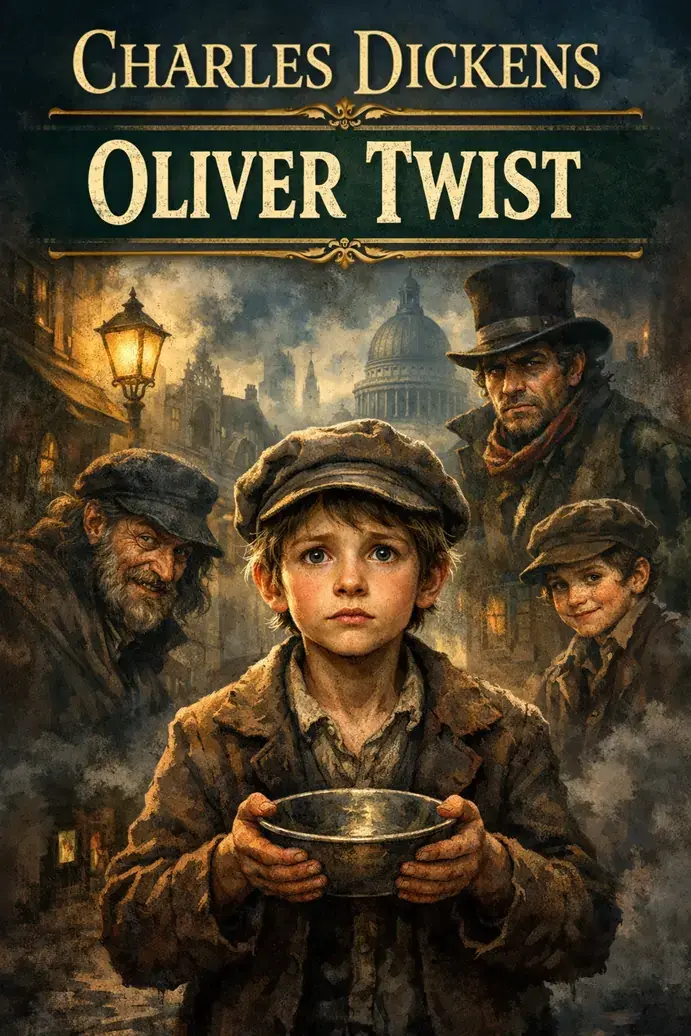
The novel is often called a social one, but it stands on more than exposure and condemnation. At its center is Oliver’s character—his stubborn determination to remain a human being, even when people try to turn him into a “convenient” shadow with no voice and no rights.
Dickens’s London isn’t a backdrop; it’s a living landscape of temptations and threats, where it’s easy to lose yourself and hard to keep trusting others. That’s why the book is still read as a tense, emotionally precise coming-of-age story—one that doesn’t let go after the final page.
Oliver Twist – Summary & Plot Overview
Oliver Twist is born in a poorhouse, where life from the very first minute feels less like care and more like cold bookkeeping. His mother dies almost immediately after giving birth, never managing to name the child’s father or leave any information about herself. And so Oliver becomes “no one’s”—a convenient unit in a system that exists not to rescue people, but to minimize costs.
The boy’s childhood passes in hunger, punishment, and humiliation: the children are given a meager ration, treated like a burden, and taught that pity is an unnecessary weakness. When Oliver, driven to desperation, dares to ask for a second serving, he unwillingly becomes a symbol of defiance. That famous moment sets off a chain of events: the adults are frightened not by the children’s hunger, but by the very fact that a child has dared to “demand more than his share.”
As punishment, they try to place Oliver anywhere—anything to get rid of the “dangerous” boy.
He is sent as an apprentice to the undertaker, Mr. Sowerberry, and at first glance, it seems like an improvement. At least there’s a roof over his head, and the food sometimes looks like real food. But the undertaker’s house quickly proves that cruelty can live behind the doors of a “respectable” trade as well.
Oliver endures constant mockery from the household, and especially from the rough apprentice Noah Claypole. The situation comes to a head when Noah dares to insult the memory of Oliver’s mother. The boy, usually quiet and patient, fights back for the first time. For that, they try to “tame” him by force, and with no other way out, he runs.
That’s how the road to London begins—exhausting, lonely, almost hopeless, yet filled with a stubborn inner resolve. Oliver keeps going with no money, no connections, and no certainty that anyone is waiting for him at all.
In the capital, he meets a quick, friendly boy known as the Artful Dodger. The Dodger seems like a good-natured guide—someone who knows the city and can help. And it’s through him that Oliver ends up in Fagin’s house, the home of an old receiver of stolen goods who holds together a whole crew of child pickpockets.
Oliver doesn’t yet understand what kind of world he’s been pulled into. He’s given food, promised “work,” spoken to almost kindly, and after poorhouses and beatings, that softness feels like rescue. But very quickly it becomes clear that the “care” here is part of the trap.
They try to teach Oliver that stealing is just a trade, and that other people’s wallets and watches are simply spoils—taken from those who were weaker. For a child raised without family or protection, that logic can be deadly: it replaces morality with a simple rule of survival. Yet Oliver resists from the inside, and it’s precisely his incorruptibility that irritates the criminal world more than any threat ever could.
When the boy is taken out on his first “job,” he finds himself alongside the Artful Dodger and Charley Bates as they deftly pick the pocket of a passerby. Oliver doesn’t even have time to understand what’s happening, but he is taken for a thief. A chase begins, the crowd is ready to tear a child apart, and only the intervention of the very man who was robbed—Mr. Brownlow—changes the outcome.
Brownlow sees that he’s facing not a hardened criminal, but a frightened boy, and he takes Oliver under his protection. This turn matters not only for the plot: for the first time in his life, Oliver meets an adult who doesn’t want to use him, but tries to understand him.
In Brownlow’s home, the boy receives care, decent food, calm, and a sense of safety. It feels as if fate has finally moved a step toward justice, and the reader, too, begins to believe that a happy ending might be possible.
But the novel follows a different logic: Dickens shows that a child from the bottom of society can’t simply “walk out” of trouble, because forces are at work around him—forces that are used to owning people. Fagin and his circle don’t want to lose Oliver: to them, he is both a useful tool and a dangerous witness.
Bill Sikes enters the story—a brutal, violent criminal for whom cruelty is a native language. With the help of Nancy, a girl from the gang, Sikes kidnaps Oliver and drags him back into the criminal world. Here Nancy’s tragic double nature becomes especially clear: she takes part in wrongdoing, yet there is compassion in her, and an inner weariness with the life she was raised in.
Her role in the story constantly wavers between fear and an attempt to do at least something right—before it’s too late.
Oliver once again falls under the control of people for whom he is nothing but property. He is threatened, isolated, and denied any chance to ask for help. Then they force him to take part in a burglary at a house in the suburbs.
This episode becomes the nightmare’s peak: the child is used as a “convenient” accomplice—small enough to squeeze where an adult can’t, and, if necessary, easy to blame. During the crime, everything goes wrong, a shot rings out, and Oliver is wounded. The criminals abandon him, and the boy—half-frozen and barely standing—makes his way to the very house they tried to rob.
Here, the novel takes another sharp turn. The mistress of the house, Mrs. Maylie, and her ward, Rose, do not reject him; they help him. It becomes the story’s second “island” of goodness—proof that mercy is possible even in a world where evil seems built into the system.
From there, the plot gradually widens and becomes not only a story about saving a child, but also an investigation into his origins. New figures enter Oliver’s life—people connected to the secret of his birth, to documents, inheritance, and an old injustice that has never been set right.
A key role is played by Mr. Monks, a man who, for personal reasons, is determined to destroy Oliver’s reputation and rob him of any future. What makes his actions especially dangerous is that this is a different kind of evil: not blunt, like Sikes’s, but calculated and “respectable.” Monks tries to ensure that Oliver’s origins remain forever “shameful,” and that the boy himself is condemned to a lowly fate.
In this way, Dickens shows that the threat to a child comes not only from alleyways and criminal dens, but also from people who know how to hide cruelty behind a decent façade.
In parallel, the novel follows Nancy’s storyline as she begins to realize that Oliver is facing destruction. Guilt and compassion win out in her: she decides to warn those who might be able to help the boy. Her choice is one of the book’s most tense and tragic moments, because it requires her to stand against the world she lives in—and against the people she fears.
Nancy meets with Mr. Brownlow and Rose, reveals key details of the plot, and in doing so sets the final resolution in motion. But the criminal world does not forgive betrayal. Nancy’s story shows the price of trying to break free from an environment where violence has become normal: here, goodness is not simply a risk, but a direct sentence—especially for those who have lived too long without the right to make mistakes.
The final part of the novel brings the scattered threads together: Monks’s schemes are exposed, the circumstances of Oliver’s birth are clarified, and the criminals are trapped by the consequences of their own actions. Fagin, who for so long can seem almost comical, reveals a different scale of horror in the end—not as a funny old man, but as someone who has spent decades feeding off other people’s misery and breaking children’s lives.
Sikes, too, meets an unavoidable reckoning, and that reckoning is presented not as a neat “moral lesson,” but as the grim outcome of a life in which nothing is left except fear and aggression. And Oliver—having survived the workhouse, flight, the criminal den, and being forced into a burglary—finally gets a chance at a quiet life among people willing to love him and protect him.
And yet the novel leaves an important aftertaste: Oliver’s happy ending does not erase the fact that the system that produced his suffering still exists. Dickens deliberately sets a contrast between the rare people capable of mercy and the social machinery that makes poverty hereditary.
Oliver Twist can be read as the story of saving one child, but in every turn of the plot, you hear a larger question: how many Olivers will never meet their Brownlow, and will never make it to a house where someone opens the door to them? That combination of gripping storytelling and a social gaze is the novel’s real strength. It holds your attention like an adventure, and at the same time forces you to see that behind the “adventures” there is someone else’s life, someone else’s hunger, and someone else’s right to dignity.
Major characters
Oliver Twist
Oliver isn’t an “ideal” child from a moralizing tale, but a real boy who constantly has to defend his right to remain human. His character is revealed not through grand gestures, but through inner steadiness: he isn’t used to tenderness, yet he instinctively reaches for goodness and clings to it when he’s given a chance.
What matters, too, is that Oliver doesn’t become cruel in response to cruelty. Dickens makes him a figure of moral resistance: even when the boy is pushed into the criminal world, he refuses to accept its rules as normal. That makes Oliver seem vulnerable, but it’s precisely this vulnerability that becomes his strength—he holds on to a sense of what is right, even as the world around him spends years trying to prove the opposite.
Fagin
Fagin is one of the novel’s most unforgettable figures because he embodies evil not as a sudden outburst, but as a system. He isn’t merely a criminal; he’s someone who has built an entire “school” of survival on other people’s poverty, forcing children to steal and, by doing so, binding them to him.
His weapon is not only fear, but a kind of counterfeit care: food, a roof overhead, talk of a “profitable trade” meant to persuade teenagers that they have no choice. What makes Fagin truly frightening is his calculation. He knows how to smile, how to be gentle, even how to be amusing—so long as it serves him.
But behind that is a cold habit of breaking lives and turning childhood into a tool for profit.
The Artful Dodger
The Artful Dodger is the character through whom the reader sees how easily a child can grow used to the criminal world if no one ever offers him any other world. He’s witty, quick, confident, and at first, he comes across as almost friendly. But his “grown-up” air is a street-taught mask: the ability to talk, to maneuver, to never show fear.
The Dodger doesn’t look like a monster—and that’s exactly why he’s more frightening than he seems. He’s the product of an environment where talent and energy don’t go into growth, but into nimble fingers in other people’s pockets. And yet there’s real charisma in him, and Dickens shows how charm can conceal a tragedy.
Bill Sikes
Sikes is the novel’s raw, blunt violence. He can’t persuade the way Fagin can, and he doesn’t play at “care”—he presses with force, with threats, with the practiced habit of breaking people. There is almost no hesitation in him: he acts impulsively and brutally, like someone who has long since learned to settle everything through fear.
Sikes is dangerous because nuance disappears around him. Any feeling becomes weakness; any attempt to resist becomes a reason to strike. His storyline shows the extreme point of degradation, when a person becomes a slave to his own aggression and can no longer imagine any other way to live.
Nancy
Nancy is one of the most humane and tragic figures in the book. She lives inside the criminal world, yet she doesn’t belong to it completely: she still has the ability to feel compassion and to recognize that what’s happening to Oliver is unjust. Her inner conflict can’t be reduced to a simple “bad/good” label—she is at once a victim of circumstance, a participant in crime, and someone trying to pull at least one life out of the same abyss.
Nancy matters especially because she shows how complicated a choice can be. Escaping violence is hard not only because of fear, but because of habit, dependence, and the lack of any support to stand on. Her determination to help Oliver feels like a late—but profoundly powerful—act of dignity.
Mr. Brownlow
Brownlow is the first adult in Oliver’s life who treats him not as a problem and not as a tool, but as a child. He embodies the idea of responsibility: if you see someone else’s misfortune, you can’t stop at sympathy—you have to act.
What matters is that Brownlow isn’t just a “kind savior.” He is attentive, observant, capable of doubt, and willing to check the facts. His concern for Oliver’s fate gradually becomes both personal and principled: it’s as if he refuses to accept the idea that a child can be condemned simply because of where he came from.
In his storyline, you can hear Dickens’s faith that private goodness can step in and confront injustice.
Rose Maylie
Rose is a portrait of gentle, yet active kindness. She doesn’t perform grand heroic deeds, but it is her compassion that creates the atmosphere in which Oliver begins to recover—not only physically, but inwardly as well. Rose pays attention to details and knows how to see a child as a person, not as a “case.”
In her presence, the novel grows quieter for a while: a sense of home appears, along with safety and a kind of normal life Oliver has never been taught to expect. Rose also matters because she shows a distinctly feminine form of strength in Dickens’s world—not pressure or power, but steadfast mercy that refuses to step back.
Mrs. Maylie
Mrs. Maylie embodies a household order in which care is expressed through actions, not words. She takes Oliver in at the very moment when it would be easiest to turn him away—wounded, suspect, and tied to a crime. And that choice highlights her moral clarity.
Mrs. Maylie isn’t idealized: she can be strict, level-headed, sometimes wary, but her compassion is steady. Through her, Dickens shows that kindness is not only a feeling, but a willingness to take responsibility when it is inconvenient and risky.
Monks
Monks is a different kind of evil from Fagin or Sikes—more concealed, “respectable” on the surface, and cold within. His motives are tied to Oliver’s origins and to the fact that the boy threatens someone’s interests. Monks doesn’t act with fists, but with intrigue: what matters to him is not simply to hurt Oliver, but to destroy the child’s reputation and future, to make sure he ends up at the bottom again.
In this character, you can feel the particular cruelty of a class-bound world: sometimes what crushes hardest is not open violence, but the determination to deny someone the right to a normal life—using the law, gossip, and the “proper” connections.
Noah Claypole
Noah is a small but deeply revealing character: he shows how easily a little bit of power turns into petty cruelty. Noah isn’t a hero, and he isn’t strong, yet he relishes the chance to humiliate someone weaker. His mockery of Oliver is not just schoolyard rudeness—it reflects the wider atmosphere of a world where compassion is considered unnecessary, and humiliation is treated as an acceptable tool.
What makes Noah so unpleasant is how realistic he is. There are many people like him, and they rarely see themselves as villains, even though it is precisely this kind of behavior that builds everyday bullying and social coldness.
Mr. Bumble
Bumble is the parish official through whom Dickens mocks the hypocrisy of the “charitable” system. He speaks the right words, loves order and outward importance, but behind it lies indifference to the very people his service is supposedly meant to help. Bumble is typical in the way he treats the poor as an irritating nuisance, and orphans as mere statistics.
His portrait is satirical, but not a caricature. Dickens shows that figures like this are dangerous not because of outright malice, but because they turn human suffering into paperwork—and into routine.
Key Moments & Memorable Scenes
One of the novel’s most famous scenes is the moment when Oliver, starving and exhausted, steps forward and asks for a second serving. The power of the episode lies not in the gesture itself, but in the adults’ reaction: their horror is directed not at the children’s suffering, but at the violation of “order.”
Dickens turns this scene into a symbol. A child voices a simple request, and the system responds as if it were a revolt. It is here that the reader first sees clearly that poverty in the book is not an accident, but a mechanism—one in which compassion is treated as a danger.
Oliver’s flight to London is just as vividly memorable. The road is shown not as a romantic journey, but as a test of endurance: cold, hunger, loneliness, and a vague hope that keeps him on his feet. In these pages, Dickens captures with particular subtlety what it feels like to be a child who is afraid of everything around him and yet keeps walking—because going back is even more frightening.
At that moment, London looks like a promise of rescue, even though the reader already suspects that the city may turn out to be a trap.
Scenes in Fagin’s house are often remembered for their unsettling contrast. On one side, there is warmth, food, laughter—almost like a friendly circle. On the other hand, the slow realization that this “coziness” belongs to a criminal den where children are turned into tools.
Especially powerful is the moment when Oliver sees what the Dodger actually does and understands that they are trying to draw him into theft. Here, the novel brings out one of Dickens’s central themes: evil often arrives not with a shout, but with a smile and the promise of care.
The chase after the first pickpocketing is another powerful episode. The crowd, ready to tear a boy apart, shows how easily society can turn justice into rage. Oliver cries out that he’s innocent, but his voice is swallowed by the noise, and that sense of helplessness is especially painful.
Against this backdrop, Mr. Brownlow’s action feels almost like a miracle: he stops the mob and chooses to see a human being in the child, not a convenient culprit.
Among the most tense scenes are Oliver’s kidnapping and the way he is forced into a burglary. Here Dickens shows a different kind of fear—not fear of punishment, but fear of having no choice at all. Oliver is taken where he doesn’t want to go and made part of a crime that disgusts him.
When the burglary goes wrong, and the boy is wounded, the episode takes on a tragic clarity: a child was used and discarded like an object. And then comes a turn with a powerful emotional impact—Oliver, barely alive, ends up at the very house they tried to rob and is given help.
Mrs. Maylie’s and Rose’s mercy is especially memorable at this point because it runs against the instinct to suspect and reject.
Finally, one of the most dramatic threads is connected to Nancy. Her decision to warn Brownlow and Rose becomes a scene of moral choice: someone from the criminal world risks everything to save a child. In these episodes, the tension isn’t built on chases, but on inner struggle and the awareness of what that decision will cost.
Dickens makes them unforgettable because here goodness is shown not as a pretty feeling, but as an action—one you have to pay for.
Why You Should Read “Oliver Twist”?
Reading Oliver Twist is worth it above all for the way Dickens knows how to combine an engaging plot with a sharply observant view of society. The novel doesn’t require any special background knowledge and pulls you in easily: it has chases, a mystery of origins, dangerous encounters, and unexpected turns. But beneath the momentum, you constantly feel something else—a story about how a child becomes a hostage to a system that is supposed to protect the weak, yet in reality often makes them even more vulnerable.
Dickens shows this without dry lectures. You understand the injustice through Oliver’s fate, through everyday details, through a tone in which even small acts of cruelty feel like part of the normal routine.
The second reason is the novel’s psychological credibility and the rare humanity of its characters. It’s easy to spot vivid “villains” and “good people,” but Dickens doesn’t limit himself to a black-and-white scheme. This is especially clear in Nancy’s portrayal: her storyline makes you see how hard it is to escape a world of violence when it has become the only world you know.
Even the figures who seem satirical—officials and overseers—matter because they feel recognizable. Their indifference and self-satisfaction don’t come across as exaggerated or fantastical. That’s why the novel reads not like a museum piece of classic literature, but like a story in which real social mechanisms are easy to recognize.
Another value of the book is the atmosphere of London. In Dickens, the city isn’t a backdrop but an active force: it can lure and break you, offer a chance, and then instantly turn it into a trap. The contrast between the dark districts, the dens, and the warm homes of people willing to help creates the sense of a world where moral choice is constantly tested by circumstances.
And Dickens writes in a way that never turns scenes of “filth” into an end in themselves. He isn’t chasing shock; he is interested in how a person preserves dignity in a place where it seems almost impossible to keep it.
The novel is also valuable as a reading experience about growing up. Oliver goes through situations that could turn anyone into a cynic, yet he remains sensitive to goodness. This isn’t a naive fairy tale about “holiness,” but a serious artistic question: what is stronger in a person—circumstances or an inner core?
Dickens doesn’t make the answer too simple. He shows that one person can’t survive alone, that the mercy of others is not a decorative detail of the plot but a condition of salvation. And that is exactly why the book still hits emotionally, even for a modern reader accustomed to harsher stories.
Finally, Oliver Twist is worth reading for its language and rhythm: Dickens can be both ironic and tragic without losing clarity. His novel leaves you with the sense that a classic can still feel alive and sharp.
After the last page, what remains is not only the memory of scenes, but a quiet thought about the cost of indifference—and about how much in a human life can be changed by one simple act: seeing a child as a person and not walking past.


Comments