Slaughterhouse-Five by Kurt Vonnegut: Summary, Characters, Themes, and Ending Explained
Slaughterhouse-Five by Kurt Vonnegut is one of the most unusual and powerful novels about war in modern literature. First published in 1969, the book combines historical fiction, science fiction, satire, autobiography, and dark comedy to tell a story that refuses to follow a traditional path. At its center is Billy Pilgrim, an ordinary and passive man who survives the firebombing of Dresden during World War II and later believes he has become “unstuck in time.” Through Billy’s fragmented experiences, Vonnegut explores the lasting damage of war, the weakness of human control, and the strange ways people try to make sense of suffering.
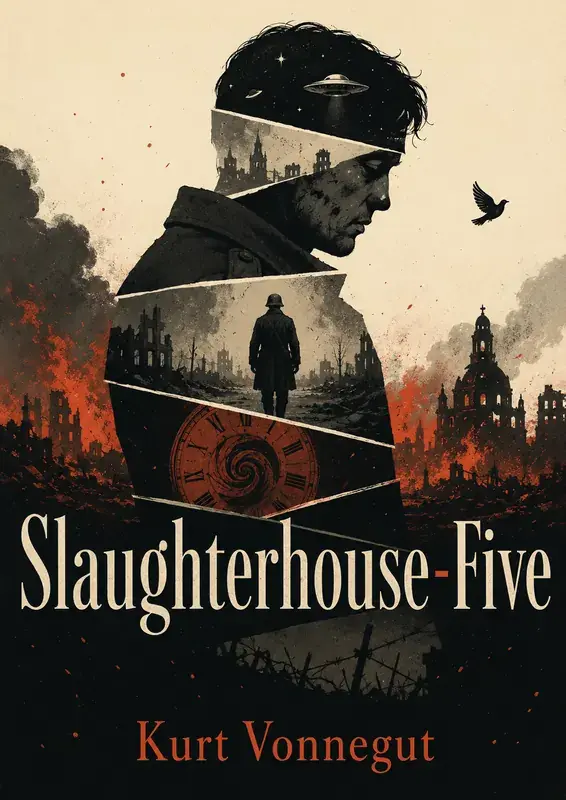
What makes Slaughterhouse-Five still important is not only its anti-war message, but also its form. The novel does not present war as heroic, orderly, or meaningful. Instead, it shows trauma as broken, repetitive, absurd, and difficult to explain. This makes the book both disturbing and deeply human, a novel that continues to challenge readers long after they finish it.
Summary and Plot Overview
Slaughterhouse-Five does not tell its story in a straight line. Instead, Kurt Vonnegut builds the novel around fragments of memory, war, fantasy, and ordinary life. This unusual structure is important because the book is not simply about what happened to Billy Pilgrim. It is also about how trauma is remembered. Events appear out of order, scenes repeat, and moments from Billy’s past, present, and future seem to exist side by side. The result is a plot that feels broken on purpose, reflecting the emotional damage caused by war.
The novel begins with a narrator who closely resembles Vonnegut himself. He explains that he has been trying for many years to write a book about the bombing of Dresden, which he witnessed as an American prisoner of war during World War II. He admits that the book has been difficult to write because the experience was too large, too terrible, and too absurd to turn into a conventional war story. He visits an old war friend, Bernard V. O’Hare, hoping to remember details, but O’Hare’s wife, Mary, is suspicious. She worries that men who write war books often make war seem exciting and heroic, encouraging future generations to repeat the same violence. The narrator promises that his book will not glorify war. This opening prepares the reader for a novel that is deliberately anti-heroic and anti-war.
After this frame, the story shifts mainly to Billy Pilgrim. Billy is introduced as a man who has “come unstuck in time.” This means that he does not experience life in normal chronological order. One moment, he is a young soldier in Europe during World War II; the next, he is a middle-aged optometrist in Ilium, New York; then, he is a child, an old man, or a prisoner on the alien planet Tralfamadore. Billy does not control these movements. He simply finds himself thrown from one moment of his life to another.
Billy’s wartime experience is central to the novel. He is not presented as a brave or skilled soldier. He is awkward, weak, poorly trained, and emotionally unprepared for combat. During the Battle of the Bulge, he becomes separated from his unit and wanders behind enemy lines with three other American soldiers: two scouts and Roland Weary. The scouts are competent and experienced, but Billy slows everyone down. Weary, who is cruel and self-important, imagines himself as part of a heroic brotherhood, but his fantasies are ridiculous and dangerous. Eventually, the scouts are killed, and Billy and Weary are captured by German soldiers.
As prisoners of war, Billy and Weary are transported with other captured Americans across Germany. The journey is miserable and humiliating. The prisoners are packed into boxcars, deprived of comfort, and treated as powerless objects rather than heroic warriors. Weary becomes seriously ill and later dies. Before his death, he blames Billy for his suffering and tells another prisoner, Paul Lazzaro, that Billy is responsible. Lazzaro, a bitter and vengeful man, later promises to kill Billy after the war. This threat remains one of the strange fixed points in Billy’s life, especially because Billy seems to accept his future death without resistance.
Billy and the other prisoners eventually arrive in Dresden, a German city that appears, at first, to be relatively untouched by the war. They are housed in an underground meat locker beneath a slaughterhouse, known as Slaughterhouse-Five. This location gives the novel its title. Because they are underground when Allied forces bomb the city, Billy and the other prisoners survive. When they emerge, Dresden has been destroyed. The city has become a landscape of ash, ruins, and death. The prisoners are forced to help remove bodies from the wreckage. This is the central historical horror of the novel, but Vonnegut does not describe it in a grand or dramatic style. Instead, he often uses plain language, understatement, repetition, and silence, suggesting that some events are too terrible for ordinary storytelling.
Outside the war narrative, Billy’s postwar life seems outwardly successful but emotionally empty. He returns to the United States, receives treatment in a veterans’ hospital, becomes an optometrist, and marries Valencia Merble, the daughter of a wealthy man. They have two children, Robert and Barbara. Billy becomes financially comfortable, but he remains disconnected from the world around him. His life after the war appears stable on the surface, yet his mind continues to move through time, returning again and again to scenes of fear, helplessness, and destruction.
One of the strangest parts of Billy’s story is his claim that he was kidnapped by aliens from the planet Tralfamadore. The Tralfamadorians place him in a zoo, where he is displayed with Montana Wildhack, a movie star who is also brought to the planet. The aliens teach Billy their philosophy of time. According to them, all moments exist forever, and death is only one moment among many. They believe that free will is an illusion and that people should focus on pleasant moments rather than painful ones. This idea deeply affects Billy. He begins to repeat their fatalistic attitude, especially through the phrase “So it goes,” which appears whenever death is mentioned.
The Tralfamadorian episodes can be read in more than one way. On the surface, they give the novel its science fiction quality. They also provide comic absurdity, making the book stranger and less predictable than a typical war novel. At the same time, they may represent Billy’s attempt to cope with trauma. The alien philosophy gives him a way to think about death without fully feeling it. If every moment always exists, then no one is truly gone; they are simply alive in another moment. But this belief also makes Billy passive. He does not fight against suffering or injustice. He accepts everything, including his own murder, as unavoidable.
The novel repeatedly moves toward Billy’s death, even though it has already been announced before it happens. In the future, Billy gives public speeches about time and Tralfamadore. He knows that Paul Lazzaro will eventually have him killed, but he does nothing to prevent it. When the assassination finally occurs, Billy treats it as just another moment in time. This removes suspense in the traditional sense. Vonnegut is not trying to make readers wonder what will happen next. Instead, he wants them to think about how events are remembered, repeated, and interpreted.
By the end of Slaughterhouse-Five, the narrative returns to the aftermath of Dresden. The war is ending, but there is no sense of victory or moral clarity. The destruction has happened, the dead remain dead, and the survivors are left with memories that cannot be neatly explained. The final sound in the novel is the bird call “Poo-tee-weet?” This strange, meaningless question suggests that after mass death, language itself may fail. There may be no intelligent explanation for war’s cruelty.
In this way, the plot of Slaughterhouse-Five is both simple and deeply fragmented. Billy Pilgrim survives a terrible event, lives an ordinary life afterward, and comes to believe in a universe where everything is fixed. But the novel’s real power lies in how that story is told. By breaking time apart, mixing realism with fantasy, and refusing heroic meaning, Vonnegut creates a war novel that feels wounded, ironic, and unforgettable.
Historical Context: Dresden, World War II, and Vonnegut’s Experience
The historical background of Slaughterhouse-Five is essential to understanding the novel. Although the book includes time travel, aliens, satire, and absurd comedy, it is rooted in a real event: the Allied bombing of Dresden in February 1945. Dresden was a German city that had once been known for its beauty, architecture, and cultural life. Near the end of World War II, it was heavily bombed by British and American forces. The attack created massive firestorms and destroyed much of the city. Thousands of civilians were killed, and the scale of the destruction left a deep mark on those who witnessed it.
Kurt Vonnegut was one of those witnesses. As a young American soldier, he was captured by German forces during the Battle of the Bulge and taken as a prisoner of war. He and other prisoners were sent to Dresden, where they were housed in an underground meat locker beneath a slaughterhouse. Because they were below ground during the bombing, they survived. When they came out afterward, they saw the ruined city and were forced to help collect bodies from the wreckage. This experience became the central event behind Slaughterhouse-Five, even though Vonnegut waited many years before turning it into a novel.
This long delay is important. Vonnegut does not present Dresden as an easy subject to explain. In the first chapter, the narrator admits that he has struggled to write his “Dresden book.” He cannot turn the event into a simple story of bravery, victory, or patriotic meaning. The bombing was too horrific, and his memories are too fragmented. This difficulty shapes the entire novel. Instead of writing a traditional war story, Vonnegut creates a broken, non-linear narrative that reflects the confusion and emotional damage caused by war.
The novel was published in 1969, during the Vietnam War era, when many readers were questioning military power, political authority, and the morality of war. This helped Slaughterhouse-Five become especially powerful for its original audience. Although the novel looks back to World War II, it also speaks to broader questions about modern warfare. Vonnegut does not focus only on soldiers fighting soldiers. He is interested in the destruction of cities, the deaths of civilians, and the way governments often turn mass violence into strategy or necessity.
The bombing of Dresden also complicates simple ideas of good and evil in wartime. World War II is often remembered as a morally clear conflict because Nazi Germany was responsible for immense crimes. Vonnegut does not deny that reality. However, he also forces readers to face the suffering caused by the Allied side. This does not make the novel a defense of Germany or an attack on Allied soldiers. Instead, it shows that war can produce horror even when fought against a terrible enemy. The destruction of Dresden becomes a symbol of how war reduces human beings to numbers, bodies, and ruins.
Vonnegut’s personal experience also explains the novel’s unusual tone. Slaughterhouse-Five is not written in a grand, emotional style. Many terrible events are described with plain language, dark humor, and repeated phrases such as “So it goes.” This style can seem cold at first, but it reflects the way trauma can make emotion difficult to express directly. The narrator often avoids dramatic language because dramatic language might make war seem meaningful or beautiful. Instead, the book’s simplicity makes the horror feel more disturbing.
The historical context also helps explain Billy Pilgrim’s passivity. Billy is not a traditional war hero because Vonnegut does not believe that traditional heroism can honestly represent experiences like Dresden. Billy is weak, confused, frightened, and often powerless. In this sense, he represents the ordinary person caught inside enormous historical forces. He does not control the war, the bombing, or even his own memories. His helplessness reflects one of the novel’s central ideas: in modern war, individuals are often trapped inside events too large for them to understand or resist.
By connecting personal memory with historical disaster, Slaughterhouse-Five becomes more than a novel about one man’s strange life. It is also a response to the twentieth century’s capacity for organized destruction. Vonnegut uses Dresden not as a background detail, but as the moral center of the book. Everything in the novel, from its broken timeline to its science fiction elements, circles around that event. The result is a work that asks readers not to admire war, but to question the stories that make war seem noble, necessary, or clean.
Main Characters
Billy Pilgrim
Billy Pilgrim is the central character of Slaughterhouse-Five. He is an American soldier in World War II, a survivor of the Dresden bombing, and later a successful optometrist in Ilium, New York. Unlike the usual hero of a war novel, Billy is passive, awkward, frightened, and physically unprepared for combat. He does not show bravery in a traditional sense, and he rarely takes control of what happens to him. This makes him an unusual but important figure in the novel because Vonnegut uses him to challenge the idea that war creates noble heroes.
Billy’s most famous characteristic is that he has “come unstuck in time.” He moves without warning between different moments of his life: childhood, war, marriage, middle age, old age, his time on Tralfamadore, and even his death. These time shifts can be read as science fiction, but they also suggest trauma. Billy cannot leave the past behind because the past keeps returning to him. His strange relationship with time reflects the lasting psychological damage caused by war.
Kurt Vonnegut as Narrator
Kurt Vonnegut appears in the novel as a narrator who is both inside and outside the story. In the first chapter, he describes his struggle to write a book about Dresden, where he was held as a prisoner of war. This narrator gives the novel an autobiographical frame and reminds readers that the story is connected to real historical experience.
Vonnegut’s presence is important because it prevents the novel from becoming a simple fictional adventure. He openly admits the difficulty of writing about war and questions whether language can truly represent such destruction. His voice is ironic, honest, and sometimes self-critical. By including himself, Vonnegut shows that Slaughterhouse-Five is not only Billy Pilgrim’s story, but also the story of a writer trying to understand and communicate trauma.
Roland Weary
Roland Weary is an American soldier who travels with Billy after they become separated from their unit. He is cruel, immature, and obsessed with violent fantasies. Weary imagines himself as part of a heroic group of soldiers, even though reality does not support this fantasy. He wants war to be dramatic and meaningful, but his behavior is often selfish and ridiculous.
Weary serves as a satire of false heroism. He represents the kind of person who has absorbed romantic ideas about war from books, films, and popular culture. Instead of becoming noble through combat, he becomes more pathetic and dangerous. His treatment of Billy shows how cruelty can exist even among people on the same side. Before dying, Weary blames Billy for his suffering, which later leads Paul Lazzaro to seek revenge.
Paul Lazzaro
Paul Lazzaro is another American prisoner of war and one of the novel’s most unpleasant characters. He is small, bitter, and driven by revenge. Lazzaro believes deeply in the importance of paying people back for any insult or injury. His worldview is narrow and violent, based almost entirely on resentment.
Lazzaro becomes important because he promises to kill Billy Pilgrim after the war, blaming him for Roland Weary’s death. Billy later accepts this future murder as something fixed and unavoidable. Lazzaro, therefore, represents the persistence of violence beyond the battlefield. Even after the war ends, hatred continues. Through him, Vonnegut shows that war does not simply stop when armies stop fighting; it leaves behind habits of revenge, brutality, and emotional damage.
Edgar Derby
Edgar Derby is an older American prisoner of war and one of the more decent characters in the novel. He is a former high school teacher who volunteered for the army despite being older than many of the other soldiers. Derby is thoughtful, moral, and more serious than many of the men around him. He represents an older idea of dignity and responsibility.
His fate is one of the darkest ironies in the novel. After surviving the bombing of Dresden, Derby is executed for taking a teapot from the ruins. This punishment is absurd when compared with the mass destruction that has just occurred. His death exposes the moral madness of war: a city can be destroyed, and thousands can die, yet one man is formally executed for a small act of theft. Derby’s story is one of Vonnegut’s clearest examples of bitter irony.
Valencia Merble Pilgrim
Valencia Merble Pilgrim is Billy’s wife. She comes from a wealthy family and helps Billy enter a comfortable middle-class life after the war. Valencia loves Billy deeply, but their relationship is emotionally uneven. Billy seems distant from her, as he is from much of his postwar life. He marries her partly because it is expected and practical rather than because of strong romantic passion.
Valencia represents the ordinary American life Billy enters after surviving the war: marriage, children, business success, and material comfort. However, this normal life does not heal him. Her presence shows the distance between outward stability and inner damage. Billy may appear successful, but he remains psychologically detached. Valencia’s tragic death after Billy’s plane crash also adds to the novel’s repeated pattern of sudden, absurd loss.
Barbara Pilgrim
Barbara Pilgrim is Billy and Valencia’s daughter. After Billy begins publicly speaking about Tralfamadore and time travel, Barbara becomes frustrated, embarrassed, and worried about him. She treats him as someone who has lost touch with reality and tries to manage his life.
Barbara’s role is important because she represents the practical, skeptical response to Billy’s strange beliefs. To her, his stories are not cosmic wisdom but signs of mental instability. She also shows the generational distance between Billy and his family. Billy’s trauma is not easily understood by those around him, and his own children cannot fully reach him. Through Barbara, the novel shows how war trauma can isolate survivors even within their families.
Montana Wildhack
Montana Wildhack is a movie star who appears in Billy’s Tralfamadorian experiences. She is placed with Billy in the alien zoo, where the Tralfamadorians observe them as human specimens. She and Billy eventually live together there and have a child.
Montana’s role is strange because she belongs mostly to the novel’s science fiction layer. However, she also reflects Billy’s desire for a simplified alternative life, separate from war, family expectations, and human history. Life with Montana on Tralfamadore seems artificial, but it gives Billy a kind of fantasy domestic peace. At the same time, the fact that they are displayed in a zoo reminds readers that this peace is not true freedom. It is another form of captivity.
The Tralfamadorians
The Tralfamadorians are aliens who, according to Billy, kidnap him and teach him a new way of understanding time. They believe that all moments exist forever and that death is only one moment among many. From their perspective, free will does not exist. Everything that happens has always happened and always will happen.
These aliens are central to the novel’s philosophical structure. Their view of time gives Billy comfort because it allows him to see death differently. However, it also encourages passivity. If everything is fixed, then there is no reason to resist suffering or injustice. The Tralfamadorians, therefore, represent both a coping mechanism and a troubling escape from moral responsibility. Their ideas help explain Billy’s emotional numbness, but they also raise one of the novel’s biggest questions: whether accepting everything is wisdom or surrender.
Main Themes and Ideas
War and Its Destructive Absurdity
The central theme of Slaughterhouse-Five is war, but Vonnegut does not present war as noble, heroic, or morally simple. Instead, he shows it as chaotic, absurd, and deeply destructive. The novel’s most important war event is the bombing of Dresden, a city that was almost destroyed near the end of World War II. Rather than describing this destruction as a glorious military achievement, Vonnegut presents it as horrifying and senseless.
Billy Pilgrim’s role in the war also challenges traditional war stories. He is not brave, strong, or heroic. He is weak, confused, badly prepared, and often helpless. Through Billy, Vonnegut suggests that war does not always reveal greatness in people. More often, it exposes their vulnerability. Soldiers are not always grand figures making meaningful choices; sometimes, they are frightened human beings trapped inside events much larger than themselves.
The absurdity of war appears most clearly in the contrast between large-scale destruction and small acts of punishment. Edgar Derby survives the bombing of Dresden, only to be executed for taking a teapot from the ruins. This moment shows the moral disorder of war. Thousands of deaths can be treated as military necessity, while one minor theft is punished with official seriousness. Vonnegut uses this irony to show how war damages logic, justice, and human values.
Trauma, Memory, and Broken Time
Billy’s experience of becoming “unstuck in time” is one of the novel’s most important ideas. On the surface, it gives the story its science fiction quality. Billy appears to move between different moments of his life without control. However, this broken experience of time can also be understood as a representation of trauma. Billy does not remember the war in a calm, orderly way. Instead, moments from the past return suddenly and repeatedly, as traumatic memories often do.
The novel’s structure mirrors Billy’s mental state. Events are not arranged in a simple beginning-middle-end pattern. The story jumps from Billy’s childhood to the war, from his postwar marriage to Tralfamadore, from his future death back to Dresden. This fragmented structure helps readers experience the confusion and instability of trauma. The past is not truly past for Billy. Dresden continues to exist in his mind, returning again and again, no matter how much ordinary life surrounds him.
This theme is especially important because Billy’s postwar success does not heal him. He becomes an optometrist, marries, has children, and gains financial comfort, yet he remains emotionally detached. Vonnegut suggests that trauma can survive beneath the surface of normal life. A person may appear stable and successful while still being inwardly broken by memories that cannot be fully explained or escaped.
Free Will, Fate, and Passivity
Another major theme in Slaughterhouse-Five is the question of free will. The Tralfamadorians teach Billy that all moments in time exist permanently and that every event is fixed. According to them, people only seem to make choices because they experience time one moment after another. In reality, they believe, everything has already happened and cannot be changed.
Billy accepts this view. It gives him comfort because it makes death seem less final and suffering seem less personal. If everything is fixed, then no one is truly responsible for what happens. There is no need to struggle against events, because events cannot be altered. This belief explains Billy’s passivity throughout the novel. He does not resist much of what happens to him, including his predicted murder by Paul Lazzaro.
However, Vonnegut does not present this philosophy as a simple answer. The Tralfamadorian view may help Billy survive emotionally, but it also raises troubling moral questions. If people believe they have no free will, they may stop resisting cruelty, injustice, and war. The novel, therefore, leaves readers uncertain. Is Billy’s acceptance a form of wisdom, or is it a symptom of emotional defeat? Vonnegut does not give a direct answer, which makes the theme more powerful.
Death and the Meaning of “So It Goes”
The phrase “So it goes” is one of the most famous elements of Slaughterhouse-Five. It appears again and again whenever death is mentioned, whether the death is human, animal, tragic, comic, natural, or violent. The repetition makes death feel constant and unavoidable. In the world of the novel, death is everywhere.
At first, “So it goes” may sound cold or emotionless. It seems to reduce death to a simple phrase, as if there is nothing more to say. But this is part of its power. The phrase suggests the failure of ordinary language in the face of mass death. After events like Dresden, emotional speeches may seem false or inadequate. “So it goes” becomes a small verbal ritual, a way of marking death without pretending to explain it.
The phrase also connects to the Tralfamadorian view of time. If all moments exist forever, then a dead person is still alive in other moments. From this perspective, death is not an ending but only one part of a larger pattern. Yet the repetition of “So it goes” can also feel disturbing because it risks making death seem too acceptable. Vonnegut uses the phrase in a way that is both comic and tragic, comforting and unsettling.
Satire and the Rejection of Heroic War Stories
Slaughterhouse-Five is a deeply satirical novel. Vonnegut mocks many of the ideas that usually appear in traditional war stories: courage, glory, masculine honor, patriotic excitement, and heroic sacrifice. He does not deny that people can be brave or decent, but he refuses to turn war into entertainment.
Roland Weary is one of the clearest examples of this satire. He wants to see himself as a heroic soldier and imagines a dramatic story about comradeship and danger. But his fantasy is ridiculous, and his behavior is cruel rather than noble. Through Weary, Vonnegut criticizes the romantic imagination that makes war seem attractive before people understand its reality.
The narrator’s promise to Mary O’Hare also supports this theme. Mary fears that books about war often make soldiers look like glamorous men instead of frightened young people. The narrator responds by presenting war as something childish, wasteful, and ugly. This is why the novel is sometimes called “The Children’s Crusade.” The phrase reminds readers that many soldiers are very young and are sent into violence by older political and military systems.
The Limits of Language and Explanation
A quieter but important theme in the novel is the failure of language. Vonnegut repeatedly suggests that some experiences cannot be properly explained. The bombing of Dresden is so destructive that ordinary storytelling seems inadequate. This is one reason the novel is fragmented, ironic, and strange. A neat, realistic narrative might make the event seem more understandable than it really is.
The final bird call, “Poo-tee-weet?”, captures this idea. After mass death, the bird’s meaningless sound is the only possible response. It does not explain anything, justify anything, or provide comfort. It simply exists. This ending suggests that war leaves behind a silence that human language cannot fill.
Vonnegut’s simple style is part of this theme. He often avoids dramatic description and uses short, plain sentences. This does not weaken the horror; it makes it sharper. By refusing grand language, he avoids making destruction beautiful. The novel’s restraint shows that sometimes the most honest response to suffering is not explanation, but humility.
Symbols, Motifs, and Writing Style
“So It Goes”
The phrase “So it goes” is the most recognizable motif in Slaughterhouse-Five. Vonnegut repeats it after almost every mention of death, whether the death is tragic, absurd, large-scale, or seemingly minor. The phrase appears after descriptions of soldiers, civilians, animals, and even champagne going flat. This repetition creates a strange emotional effect. At times, it sounds calm and accepting. At other times, it feels cold, empty, or deeply ironic.
The phrase is closely connected to the Tralfamadorian philosophy of time. If all moments exist forever, then death is only one moment among many, not the final truth of a person’s existence. Billy Pilgrim adopts this way of thinking because it helps him endure the horror of Dresden and the many losses in his life. However, Vonnegut does not allow the phrase to become simple comfort. Its constant repetition also shows how common death is in war and how difficult it is to respond meaningfully to so much suffering.
Time Travel
Billy’s time travel is one of the novel’s central devices. He moves without warning between different parts of his life: childhood, World War II, his marriage, his career as an optometrist, his time on Tralfamadore, and his death. This makes the novel feel fragmented and unpredictable, but the structure is not random. It reflects Billy’s damaged relationship with memory.
Time travel can be read as science fiction, but it also works as a symbol of trauma. Billy does not simply remember the past; he is pulled back into it. The war is not over for him just because it has ended historically. Dresden continues to interrupt his life. By breaking chronological order, Vonnegut shows that trauma does not follow ordinary time. A terrible event can remain present long after it has happened.
Tralfamadore
Tralfamadore represents both escape and captivity. On one level, it is an alien planet where Billy is taken and displayed in a zoo. This gives the novel its science fiction quality and adds a layer of dark absurdity. On another level, Tralfamadore represents Billy’s desire to escape human history, especially the unbearable memories of war.
The Tralfamadorians teach Billy that all moments exist at once and that free will is an illusion. This belief helps him feel less afraid of death, but it also encourages passivity. Tralfamadore offers Billy a way to stop struggling against pain, yet it does not truly free him. He is still observed, controlled, and trapped. In this sense, the planet becomes a symbol of the false comfort people may seek when reality becomes too painful to face directly.
The Slaughterhouse
The slaughterhouse in Dresden is one of the novel’s most important symbols. Billy and the other American prisoners are kept in an underground meat locker called Slaughterhouse-Five. This is where they survive the bombing of the city. The location is grimly ironic: a place designed for dead animals becomes a shelter for living men while the city above is turned into a place of mass death.
The slaughterhouse also reduces human beings to the level of bodies and meat. This reflects one of the novel’s darkest ideas about war. In war, people are often treated not as individuals with names, feelings, and histories, but as physical objects to be moved, counted, buried, or destroyed. The title of the novel keeps this image at the center of the reader’s mind. It suggests that modern war can turn the world itself into a slaughterhouse.
The Bird Call: “Poo-tee-weet?”
The bird call at the end of the novel is a small but powerful symbol. After the destruction of Dresden and the repeated deaths throughout the story, the book ends not with a grand statement, but with a meaningless sound: “Poo-tee-weet?” This ending is important because it refuses to explain war or give readers a comforting conclusion.
The bird’s question suggests the failure of human language after extreme violence. What can be said after a city has been destroyed and thousands have died? A speech about heroism would feel false. A simple moral lesson would feel too easy. The bird call leaves readers with emptiness, confusion, and silence. It is one of Vonnegut’s clearest ways of showing that some horrors cannot be made meaningful.
Fragmented Structure
The structure of Slaughterhouse-Five is itself symbolic. The novel does not move from beginning to middle to end in a normal way. Instead, it jumps across time, repeats events, and reveals important outcomes before they happen. Billy’s death, for example, is announced before the reader reaches it in the narrative. This removes traditional suspense and changes the reader’s attention. The question is not simply “What will happen?” but “What does it mean that these events keep returning?”
This fragmented structure reflects the mental effects of trauma. Billy’s life does not feel whole or orderly because his memory has been broken by war. The form of the novel, therefore, matches its subject. Vonnegut does not just tell readers that trauma is disorienting; he makes the reading experience disorienting as well. The broken timeline becomes part of the book’s emotional truth.
Vonnegut’s Writing Style
Vonnegut’s writing style in Slaughterhouse-Five is simple, direct, ironic, and deeply controlled. He often uses short sentences and plain language, even when describing terrible events. This style may seem casual at first, but it is carefully chosen. By avoiding grand or decorative language, Vonnegut prevents war from seeming beautiful, exciting, or noble.
Dark humor is also central to the style. The novel contains absurd situations, strange jokes, and comic details, but the humor does not erase the horror. Instead, it makes the horror more unsettling. Vonnegut often places comedy and tragedy side by side, forcing readers to see how ridiculous and cruel human behavior can be.
The tone of the novel is also shaped by repetition. Phrases, events, and ideas return again and again, creating a rhythm of inevitability. This repetition mirrors Billy’s experience of time and reinforces the sense that war’s damage cannot be left behind. Vonnegut’s style is therefore not just a way of telling the story; it is part of the story’s meaning. Through simplicity, irony, fragmentation, and repetition, he creates a novel that feels both emotionally restrained and morally devastating.
Ending Explained: What Does Slaughterhouse-Five Really Say?
The ending of Slaughterhouse-Five does not give readers a traditional sense of closure. There is no heroic victory, no clear moral lesson, and no emotional resolution that makes the suffering easier to accept. Instead, Kurt Vonnegut ends the novel with quietness, irony, and uncertainty. This is fitting because the whole book has resisted the usual shape of a war story. It does not build toward triumph. It circles trauma, especially the destruction of Dresden, and asks whether such an event can ever be explained in a satisfying way.
Near the end of the novel, the war is almost over. Billy Pilgrim and the other prisoners have survived the bombing of Dresden because they were underground in the meat locker of Slaughterhouse-Five. When they come out, the city above them has been destroyed. The beautiful city has become a landscape of ruins and death. The prisoners are then forced to help remove bodies from the wreckage. This is one of the most important moments in the book because it shows the terrible gap between military language and human reality. A bombing may be described as a strategy, but on the ground, it leaves bodies, silence, ash, and survivors who must carry the memory.
The final image of the bird saying “Poo-tee-weet?” is especially important. After so much death, the novel ends with a meaningless sound. The bird’s question does not explain anything. It does not comfort the reader or turn the destruction into a lesson. This suggests that after mass violence, language itself becomes inadequate. Human beings may want reasons, speeches, or moral conclusions, but Vonnegut refuses to offer anything that would make Dresden seem understandable. The bird call becomes a symbol of what remains when words fail.
Billy’s own ending is also unusual because the reader knows about his death before it happens. Billy has already learned, or believes he has learned, that Paul Lazzaro will have him killed. But Billy does not try to escape this fate. Influenced by the Tralfamadorian view of time, he accepts death as just one moment among many. To the Tralfamadorians, every moment exists forever, so a person who is dead in one moment is still alive in other moments. This idea gives Billy a kind of peace, but it is an uneasy peace. It may help him survive psychologically, yet it also makes him passive.
This is one reason the novel’s ending is complex. Vonnegut does not simply tell readers to adopt Billy’s philosophy. The idea that everything is fixed can sound comforting, especially in the face of grief. But it can also become dangerous if it teaches people not to resist cruelty or injustice. If war is treated as unavoidable, then no one has to take responsibility for it. The novel leaves this tension unresolved. Billy’s acceptance may be a coping mechanism, but it is not necessarily moral wisdom.
The ending also reinforces the book’s anti-war message. Vonnegut does not argue against war by giving a long political speech. Instead, he shows how war breaks time, memory, language, and meaning. The destruction of Dresden cannot be turned into a noble adventure. It cannot be repaired by patriotic language or heroic storytelling. By ending with a bird’s meaningless question, Vonnegut suggests that the honest response to such violence may be silence, confusion, and grief rather than explanation.
In the end, Slaughterhouse-Five says that war is not only destructive because it kills people. It is also destructive because it damages the way survivors understand life afterward. Billy lives on, but his life is fragmented. He moves through time, repeats phrases, accepts death, and retreats into strange beliefs that may or may not be true. His survival is not presented as simple healing. It is a damaged continuation.
That is why the ending remains powerful. It does not close the wound. It leaves the reader with the feeling that some events cannot be made whole by storytelling. Vonnegut’s final message is not that life is meaningless, but that certain kinds of violence make meaning terribly difficult. The novel asks readers to distrust any version of war that sounds clean, heroic, or easy to explain. After Dresden, after all the deaths, the only sound left is the bird asking, “Poo-tee-weet?”


Comments