The Handmaid's Tale by Margaret Atwood: Summary, Characters, Key Moments & Review
Margaret Atwood’s novel The Handmaid’s Tale is one of the most talked-about dystopian works of the late twentieth century. At first glance, it is a dark story about a woman stripped of her name and her freedom in a theocratic state. But from the very first pages, it becomes clear that we are dealing with more than just a piece of speculative fiction about a “post-catastrophe world”: it is a painfully recognizable reflection of contemporary fears and social conflicts.
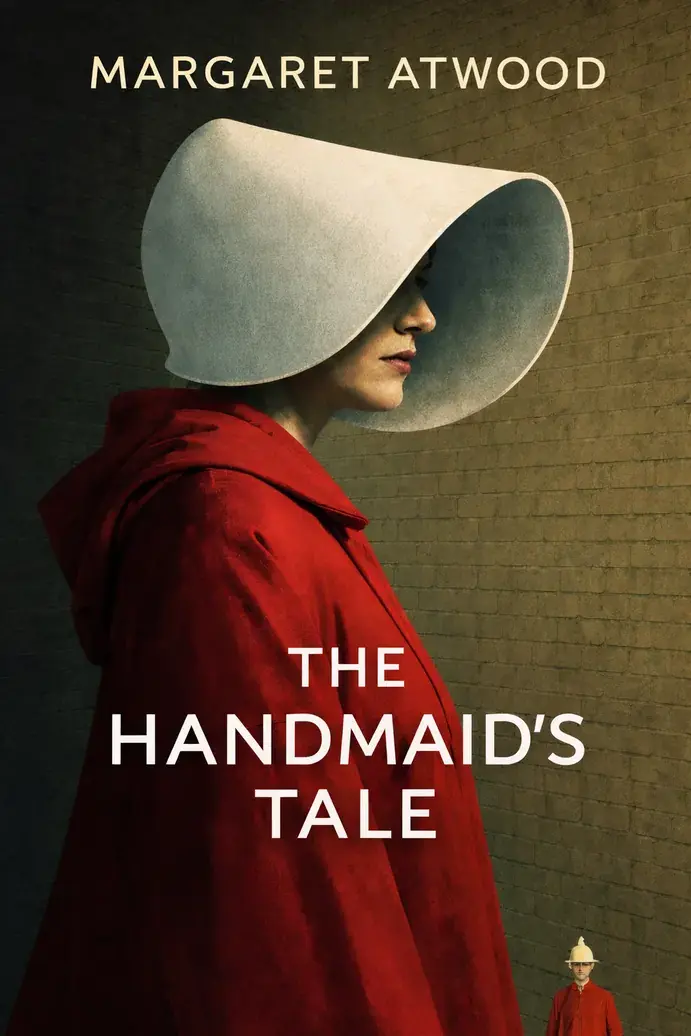
Atwood deliberately constructs her world out of details we have already seen in history and politics: religious fanaticism, control over the body, and propaganda that erases individuality. This makes the book sound all the more alarming and convincing, like a warning addressed to every reader. The Handmaid’s Tale forces us to look anew at familiar words—freedom, body, choice, power—and to think about how fragile the rights we take for granted really are. It is not just a novel about dictatorship, but a profound meditation on the way fear and indifference clear the path for tyranny. It is no surprise that, decades later, the novel continues to be reprinted, adapted for the screen, and discussed in the context of feminism, human rights, and politics.
The Handmaid's Tale – Summary & Plot Overview
The novel is set in the near future, on the territory of what used to be the United States, where a democratic system has been replaced by the theocratic Republic of Gilead. Under the pretext of fighting chaos, terrorism, and a catastrophic decline in birth rates, power is seized by religious fanatics. Society is built on a rigid hierarchy, and women’s lives are entirely subordinated to the state. Some women are stripped of property and rights and turned into “handmaids” — living incubators whose only “function” is to bear children for high-ranking families.
The story is told in the first person. The heroine, known to us as Offred, lives in the house of the Commander and his wife, Serena Joy. This is not her real name but a label of ownership: “Of-Fred,” belonging to Fred. She is allowed to go out shopping only in the company of another handmaid, lives by a strict schedule, and is forbidden to read, write, or communicate freely. Patrols roam the streets, the Eyes watch everyone, and the bodies of those executed as “traitors to the regime” are regularly displayed on the Wall. In these conditions, Offred tries to preserve what is left of her inner freedom and the memory of her former life.
The narrative constantly shifts between the present and her recollections. Scenes from the “old” America surface: work, cafés, meetings with her husband Luke, an ordinary life in which she still had control over her own money and her own body. Step by step, the system of restrictions tightens: women are banned from working, their bank accounts are frozen, protests fill the streets, and eventually even attempts to escape become impossible. At one point, Offred, Luke, and their little daughter try to cross the border and flee to Canada, but the plan fails. It is after this that she ends up in the hands of the new regime.
Before she becomes a handmaid, the heroine passes through the “Red Center” — an institution where women are broken and retrained to meet Gilead’s needs. It is ruled by the Aunts, led by the stern Aunt Lydia. They instill a new morality: a woman is “by nature” guilty, she must be modest, obedient, and forget about education and a career. Offred meets the rebellious Moira, who refuses to submit and openly resists. For her, Moira becomes a symbol of another, freer life, a reminder that fear is not the only possible response to violence.
Offred’s present is a ritual. Once a month, the “ceremony” takes place: during ovulation, the handmaid lies between the knees of the legal wife while the Commander performs an act that is officially framed as a prayer and “sacred duty.” Intimacy has nothing to do with it; everything is stripped down to a mechanical procedure. And yet even here, Offred tries to preserve what is left of herself, thinking, observing, comparing. Her internal monologue is full of irony, pain, and fragments of memory, which gives the story a sense of authenticity and fragility.
Over time, the established order in the house begins to crumble. The Commander secretly invites Offred to his room in the evenings. Instead of sermons, he suggests they play Scrabble, gives her forbidden magazines, and tries to have confidential conversations. For him, this is a game with power and a way to feel “special” among the ruling elite. For her, it is a dangerous deviation from the rules that nevertheless brings a sense — however illusory — of having a choice. Later, he secretly takes her to the underground brothel Jezebel’s, where, in the half-flippant atmosphere of luxury and depravity, the heroine suddenly sees Moira, broken but still recognizably herself.
In parallel, Serena Joy, embittered by her infertility and humiliated by the rituals, suggests that Offred have a child by the chauffeur Nick to save the family’s reputation. This is how another secret storyline begins — no longer imposed from above, but born at the intersection of risk and mutual desire. Offred’s relationship with Nick becomes not only a physical experience, but also the last remaining island of human tenderness in a world where the body has long since been turned into a tool. She starts allowing herself to dream, even though she knows that any careless move could cost her her life.
Through her walking partner, another handmaid, Offglen, the heroine learns about the existence of the underground resistance movement, Mayday. Yet even this knowledge does not give her a clear path to freedom: fear has seeped too deeply into everyday life, and people have grown far too used to surviving rather than fighting back. Later, Offred commits suicide so as not to betray her comrades after being arrested, and this becomes for Offred yet another reminder of how high the price of any step against the regime really is.
By the end of the novel, the tension keeps mounting. Offred suspects that she is being watched, Serena finds proof of her secret contacts, and the atmosphere in the house grows heavier and heavier. When a car belonging to the Eyes arrives for the handmaid, it is impossible to tell whether this is an arrest or a rescue. Nick whispers to her that the men in black uniforms are members of Mayday and urges her to trust them. The final lines of her narrative break off at the moment when she steps into the unknown, balancing between hope and fear.
The novel concludes with an unusual afterword in the form of a lecture by a scholar of the future, who, many years later, analyzes the recordings left by Offred. This device turns a personal story into a historical document, showing that Gilead has fallen, yet at the same time leaves a lingering sense of ambiguity: the heroine’s fate remains unclear. In this way, The Handmaid’s Tale combines the intimate, subjective voice of a single woman with a large-scale view of an entire era in which private life and high politics prove to be inseparably intertwined.
Major characters
Offred
Offred is the narrator and main voice of the novel, through whom the reader learns both about Gilead and about life “before.” Her real name is deliberately withheld: this emphasizes how the system crushes individuality and turns a woman into a function. On the surface, Offred seems passive: she follows the rules, tries not to stand out, and doesn’t rush into open rebellion. But inside, she is constantly fighting — for memory, for the ability to feel, for the right to her own thoughts. Her inner monologue weaves together fear, irony, despair, and quiet stubbornness. Through her, we see how fragile the human psyche is under the pressure of terror, and how even the smallest acts of resistance — remembering a name, not forgetting a daughter’s face, keeping a sense of humor — turn into acts of defiance.
Commander
The Commander is the master of the house to which Offred is assigned, one of the pillars of Gilead’s elite. Outwardly, he embodies power: a middle-aged man, confident in his right to decide other people’s fates. However, in his private encounters with Offred, he gradually reveals himself as bored, in his own way lonely, and morally divided. He is nostalgic for the “old world,” secretly plays Scrabble with her, gives her magazines to read, makes small talk, clearly enjoying the fact that he is breaking his own rules. At the same time, the Commander does not see himself as a villain: he justifies the system with noble aims, as if experimenting on people, refusing to admit that he himself is one of its architects. His figure shows how easily a person in power can combine cruelty with everyday ordinariness.
Serena Joy
Serena Joy is the Commander’s wife, a woman who once, back before Gilead, publicly championed “traditional values,” and has now become their prisoner. Her image is filled with bitterness and contradictions. She lives in a luxurious house, bears the symbols of status, yet is deprived of intimacy, motherhood, and the ability to control her own life. Serena is cold, sharp, and often cruel toward Offred, because she sees in the Handmaid a living reminder of her own infertility and humiliation. At the same time, it is Serena who proposes that Offred start a secret relationship with Nick to “get a child” after all — this compromise with the regime and with her own convictions shows how desperation can blur the once clear line between what is “proper” and what is “forbidden.”
Ofglen
Ofglen is Offred’s assigned partner for the mandatory walks where handmaids must go out in pairs. At first, she seems like just another frightened woman, parroting slogans. But later it emerges that Ofglen is part of the underground Mayday movement. She carefully shares fragments of the truth with Offred, telling her about the resistance, covert operations, and dangerous plans. For the heroine, Ofglen becomes a doorway into a world where action and choice are still possible, not entirely confined by Gilead’s rules. Her suicide, carried out so as not to betray her comrades, is one of the novel’s most tragic and quiet sacrifices, showing the price that must be paid for trying to say “no” to the system.
Nick
Nick is the Commander’s chauffeur, a man with an uncertain status and questionable loyalties. His true role remains ambiguous to the end: he might be working for the Eyes, he might be connected to the resistance, or he might simply be trying to survive, slipping between opposing forces. For Offred, Nick becomes her main source of human closeness. Their relationship begins as a risky arrangement suggested by Serena, but quickly turns into a genuine emotional attachment. In his arms, the heroine can briefly forget about Gilead, punishments, and “ceremonies,” allowing herself a simple, almost forbidden feeling — the desire to live for more than just fear. It is Nick who, in the finale, persuades her to trust the men who come for her, and his final words remain a mystery: whether he saves her or hands her over, the reader never finds out.
Moira
Moira is Offred’s friend from the “old life” and one of the novel’s most striking figures of resistance. She is independent, sharp-witted, a bit rough around the edges, and absolutely refuses to accept the role of obedient victim. At the Red Center, Moira openly challenges the Aunts, hatches escape plans, and her audacity inspires others. For Offred, Moira is a living legend, the embodiment of the strength she herself lacks. But later, when the heroine meets her at the brothel Jezebel’s, that image falls apart. Moira is alive, but inwardly broken, and her cynical resignation to her situation makes a shocking impression. Through Moira, Atwood shows that even the fiercest rebels do not always withstand the pressure of the system — and that makes the world of the novel all the more frightening.
Luke
Luke is Offred’s husband from her “previous” life, a symbol of the world where they were able to choose, work, and raise a child without looking over their shoulders at the religious police. In the present timeline of the novel, he is absent, appearing only in fragments of the heroine’s memory: in scenes of their attempted escape, in family moments, quiet quarrels, and reconciliations. Offred does not know whether he is alive or dead, whether he ended up in a camp or managed to get away. This uncertainty turns into a constant inner ache and a sense of guilt: in her mind, she argues with him, justifies herself, recalls moments when she might have acted differently. Luke embodies the life that used to be “normal” and suddenly became irretrievable, and through him, the reader feels all the more sharply the loss of everyday, but precious things.
Professor Pieixoto
Professor Pieixoto doesn’t appear in the main narrative, but in the “Historical Notes” section, framed as a paper delivered at an academic conference in the distant future. He presents Offred’s recordings as a valuable historical source on the Republic of Gilead, yet his tone and commentary leave a mixed impression. On the one hand, he allows us to see the bigger picture: Gilead has fallen, and scholars are studying the past. On the other hand, his condescending, ironic remarks, his attempts to “excuse” the architects of the regime, and his focus on details like the authenticity of names and dates rather than on human suffering all underscore that sexism and blind spots in perception have not gone away. Through the use of Pieixoto, Atwood shows how biased even an academic perspective can be.
Aunt Lydia
Aunt Lydia is one of the most terrifying embodiments of power in the novel. She is not just an overseer at the Red Center, but also the voice of official ideology. Her speech is filled with quotations from Scripture, slogans, and distorted moral principles. She convinces women that their former freedom was a “mistake,” that they themselves are to blame for the violence, that real safety is possible only in complete submission. At the same time, Lydia knows how to be “kind,” to promise protection, to use the language of care — and that is precisely what makes her even more dangerous. She shows how ideology can speak in the voice of a “caring aunt,” gradually rewriting people’s understanding of the world.
Rita
Rita is one of the Marthas in the Commander’s house, the woman responsible for the kitchen and household chores. She is older than the handmaids, more sharply attuned to the limits of what is allowed, and initially treats Offred with a cold wariness. For Rita, handmaids are people around whom trouble always circles: too many punishments and executions are connected with them. Over time, however, small human gestures slip into her behavior — a word of support, an extra helping of food, a less severe look. Rita lives within a system where she has slightly more rights and slightly less risk, but that does not make her truly free. Her figure shows how people in the middle layer adapt to the regime, trying to survive and preserve scraps of human dignity.
Cora
Cora is the other Martha in the house, gentler and more good-natured than Rita. Unlike many, she genuinely hopes that Offred will succeed in becoming pregnant, because that would give her the chance to help look after the child, to be part of a small miracle amid the horror. In her shy smiles and her willingness to help with little things, we see that simple human kindness, which in Gilead has almost become a crime. Through Cora, we see that even those who outwardly accept the rules can still preserve an inner capacity for compassion. Her role in the book is small in volume but important in meaning: it reminds us that the world of the novel consists not only of executioners and victims, but also of countless “small,” grey people whose everyday lives are also mutilated by the regime.
Key Moments & Memorable Scenes
One of the most powerful sections of the novel is Offred’s time at the Red Center, where ordinary women are turned into handmaids. Here, the gap between the familiar world and the new reality is felt especially sharply. Aunt Lydia, smiling, explains that their former freedom was dangerous, that now women will be “protected,” while propaganda speeches play in the background and Bible verses are read aloud. The most horrifying scenes are those in which former friends are forced to take part in collective denunciations of the “guilty,” learning to fear and obey at the same time. This part of the novel shows how ideology gradually takes root in the mind until it becomes an inner voice.
Equally unforgettable is the first description of the ceremony in the Commander’s house. The scene is staged deliberately coldly, almost as something routine: the reader sees how the participants try to think of what is happening as a formality, avoiding any human emotion. Serena Joy holds the handmaid’s hands, the Commander performs his “duty,” and no one looks anyone else in the eye. The horror of the moment lies not so much in the physical violence itself as in how thoroughly it has been institutionalized and cloaked in religious language. Intimacy is turned into an instrument of power, depriving the heroine even of the right to her own shame and disgust.
A special place in the book belongs to Offred’s walks with Ofglen and the moment when Ofglen first whispers, “We aren’t all like that.” In this brief confession lies immense hope: perhaps somewhere beyond the walls of the Commander’s house, there is a network of people who do not accept Gilead. Their cautious conversations, their exchanges of half-hints and other people’s stories create the sense of an underground life running beneath the surface of official order. The later news of Ofglen’s suicide shatters this fragile feeling of safety, but it is precisely the contrast between hope and its collapse that makes these scenes so piercing.
One of the most visually striking episodes is the visit to Jezebel’s. Behind the mask of a nightclub lies a carefully concealed system of exploitation: women in revealing costumes, music, alcohol, and forbidden conversations. Offred’s encounter with Moira, who once seemed like an unbreakable rebel, becomes a collision with harsh reality: even the strongest can grow tired of resisting. In this scene, the romantic image of resistance falls apart, leaving only the inevitability of compromise and the cost of survival.
Equally powerful are the episodes at the Wall and the public executions turned into a spectacle. Offred and the other handmaids are forced to look at the bodies of “enemies of the state” hanging from hooks and, by reading their placards, guess what exactly they were killed for. Especially terrifying is the “sharing of punishment,” when the women are pushed into collectively lynching a supposed criminal. In that moment, violence becomes a communal act, and the victims temporarily find themselves on the side of the executioners. Atwood shows how easily fear and the instinct to survive turn people into accomplices, erasing the line between coercion and willing participation.
Finally, it is hard to forget the closing pages, when a car belonging to the Eyes arrives for Offred. The house is thick with tension, Serena Joy holds proof of her “betrayal” in her hands, Nick whispers that these men are from the resistance, and the whole novel narrows down to a single step: to get into the van or try to run. Atwood deliberately leaves the ending open, and this lack of resolution becomes the main emotional chord. Not knowing whether the heroine is saved or doomed, the reader is left standing on the threshold between hope and horror, while the story continues to echo in the mind long after the last page.
Why You Should Read “The Handmaid's Tale”?
The Handmaid’s Tale is not just a famous dystopia you’re “supposed to know” to navigate contemporary culture. It’s a novel that makes you feel anew the things we tend to take for granted: personal freedom, the right to say “no,” the right to control your own body and your own life. Atwood doesn’t moralize or lecture; she simply shows a world where familiar rights shift ever so slightly—and then are taken away altogether. It’s this gradualness that makes the book so frighteningly believable.
It’s also important to read this novel because it so precisely conveys the inner life of a person living without freedom. Offred is neither an ideal heroine nor a poster-girl revolutionary. She is afraid, she hesitates, she sometimes adapts, she mentally justifies herself to her past and to herself. In her voice, you can hear fatigue, irony, small everyday thoughts, flashes of desire, and guilt. This ambiguity makes the story feel alive: the reader recognizes parts of themselves in her and understands that they, too, might not become a hero of the barricades. The book speaks honestly about how hard it is to hold on to your dignity in a world that is trying to break you day after day.
Another reason to read the novel is how uncannily it speaks to today’s issues. Although it was written decades ago, many of its motifs still resonate: debates about women’s rights, state control over private life, and manipulation wrapped in the language of security and morality. Atwood deliberately includes nothing in the book that hasn’t already happened somewhere in human history. This makes Gilead not a fantasy, but a mirror assembled from real fragments—uncomfortable to look into, but necessary. The novel helps us see how thin the line is between “that could never happen here” and “it’s already happening, just in different forms.”
For all the heaviness of its themes, The Handmaid’s Tale is also a remarkably powerful work of literature. Atwood’s language is precise, at times poetic, yet always carefully controlled: every detail, object, and colour of clothing carries meaning. The structure of the novel, with its constant shifts between past and present, creates the sense of a mosaic of memory that the heroine is desperately piecing together so as not to disappear as a person. The final “Historical Notes” adds yet another layer — an ironically chilling gaze from the future at our “present,” turning Offred’s private story into a kind of document of its era.
Ultimately, this is a book that stays with you for a long time. You can’t simply close it, shrug, and forget it. It makes you argue with yourself: how much am I prepared to accept in the name of safety, where is my personal boundary, what will I call freedom? The Handmaid’s Tale doesn’t offer ready-made answers, but it asks questions that are hard to brush aside. That is why readers return to it again and again — as a warning, as a mirror, and as a story that reminds us that human dignity begins with the right to one’s own voice.


Comments