Through the Looking-Glass by Lewis Carroll: Summary and Analysis
What might happen if the world reflected in a mirror could be entered? In Through the Looking-Glass, and What Alice Found There, Lewis Carroll turns this familiar childhood curiosity into an adventure where ordinary expectations repeatedly fall apart. Published in 1871, the sequel to Alice’s Adventures in Wonderland follows Alice into a realm shaped by chess, nursery rhymes, and conversations that make perfect sense to everyone except her.
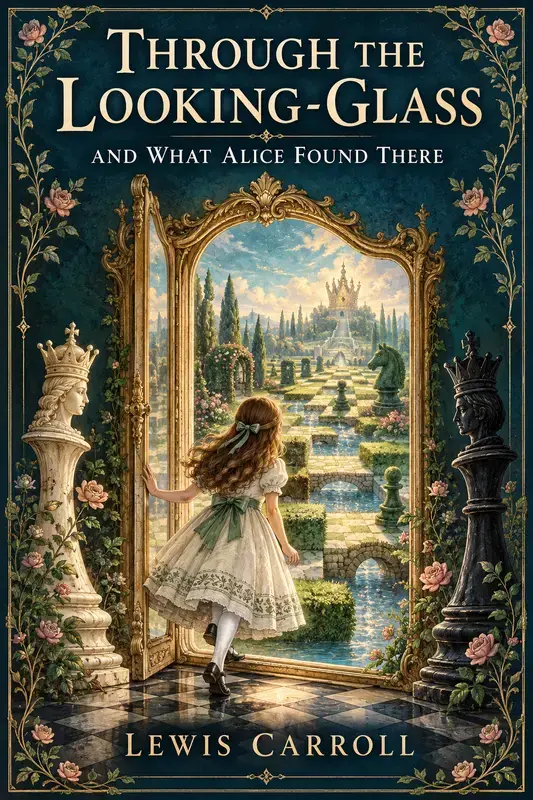
Although the novel belongs to children’s fantasy, its appeal extends beyond its young audience. Beneath the humor lie questions about identity, language, authority, and the uncertain relationship between dreams and reality. Alice tries to navigate this bewildering world with curiosity and common sense, even when words change meaning and rules seem designed to frustrate her.
The book has its own distinctive atmosphere: playful and inventive, but occasionally touched by loneliness and the passing of time. Encounters with Humpty Dumpty, the argumentative queens, and the gentle White Knight give Alice’s journey both comic energy and emotional depth. Carroll invites readers to enjoy the absurdity while questioning the familiar habits through which they understand the world.
Summary and Plot Overview: Alice’s Journey from Pawn to Queen
Spoiler disclaimer: This summary reveals the main events and ending of Through the Looking-Glass, and What Alice Found There.
Alice is sitting beside the fire with her cat Dinah and two kittens when her imagination turns toward the mirror above the fireplace. She wonders what the reflected room might conceal beyond the parts she can see. Pretending that the glass could become soft enough to pass through, she climbs onto the mantelpiece. Suddenly, the surface dissolves into a silvery mist, and Alice steps into Looking-Glass House.
The room resembles her own, but its hidden corners contain remarkable surprises. Pictures appear alive, and chess pieces walk and talk. Alice tries to help the tiny White Queen reach her daughter, Lily, although the pieces cannot see or hear their enormous visitor. She also discovers a book printed backward. Holding it before a mirror, she reads “Jabberwocky,” a strange poem about the defeat of a monster. Its unfamiliar words puzzle her, but the adventure is clear enough to excite her curiosity.
Outside, Alice finds that the paths refuse to lead where she expects. Her attempts to reach a hill repeatedly bring her back toward the house. In a garden, talking flowers criticize her appearance and discuss her as though she were another flower. They draw her attention to the Red Queen, whom Alice finally reaches by walking in the opposite direction.
The Queen speaks sharply, corrects Alice’s manners, and shows her the countryside. Streams divide the landscape into squares, making it resemble an enormous chessboard. Alice longs to join the game, especially if she can become a queen. The Red Queen agrees that she may take Lily’s place as a White Pawn, beginning on the second square and advancing toward the eighth. Their conversation includes a breathless run that leaves them exactly where they started: here, the Queen explains, running is necessary simply to remain in place.
Alice begins her journey and suddenly finds herself aboard a railway carriage with peculiar passengers, including a Goat and a gentleman dressed in white paper. Everyone objects when she cannot produce a ticket. The train leaps across a brook, carrying her forward through the chessboard. Moments later, the carriage disappears, and she is sitting beneath a tree with a large, melancholy Gnat.
The Gnat introduces her to Looking-Glass insects, including the wooden Rocking-horse-fly and the Bread-and-butterfly. After their conversation, Alice enters a wood where things have no names. She forgets the names of her surroundings and even her own. A gentle Fawn, equally unable to remember its identity, walks beside her without fear. Their companionship ends when they leave the wood: remembering that it is a fawn and Alice a human child, the animal immediately runs away.
Further along, Alice meets Tweedledum and Tweedledee, two round brothers who frustrate her efforts to ask directions. After drawing her into a dance, they insist on entertaining her with poetry. Tweedledee recites “The Walrus and the Carpenter,” in which young oysters follow two apparently friendly strangers along a beach, only to be eaten. Alice tries to decide which of the two villains behaved better, but the brothers undermine each judgment she makes.
They then show her the sleeping Red King. According to them, he is dreaming about Alice, and she exists only within that dream. If he wakes, they claim, she will vanish. Alice tearfully insists that she is real. The brothers soon become distracted by a broken rattle, which Tweedledum accuses Tweedledee of spoiling. They prepare for a battle, wrapping themselves in makeshift protective padding. Before they can fight, an enormous crow approaches and frightens them into flight.
Leaving them behind, Alice catches a windblown shawl belonging to the White Queen. This disheveled ruler introduces another difficulty: she lives backward and remembers events that have not happened yet. She screams before pricking her finger, then remains calm when the injury actually occurs. Alice struggles to follow her explanations, particularly her claim that believing impossible things becomes easier with practice.
As they cross another brook, the Queen’s voice becomes a bleat, and Alice finds herself inside a shop attended by a knitting Sheep. The goods disappear from whichever shelf Alice examines directly. Without warning, the shop becomes a boat, and Alice must row while the Sheep continues knitting. She gathers scented rushes, which fade almost as soon as she picks them. The boat then becomes the shop again, where Alice purchases an egg and walks toward it.
As she approaches, the egg grows into Humpty Dumpty, sitting precariously on a narrow wall. He treats Alice’s questions with great superiority, discussing names, birthdays, and the advantages of receiving presents on days that are not birthdays. He insists that words can mean whatever he chooses and explains several expressions from “Jabberwocky.” Confident about his safety, he claims that the White King has promised assistance if he falls. Alice eventually leaves, and a tremendous crash sounds behind her.
Soldiers and horses rush through the wood. Alice meets the White King, who has sent his forces to help Humpty Dumpty. She also encounters his messengers, Haigha and Hatta, before watching the Lion and the Unicorn fight for the King’s crown. During a pause, bread and plum cake are distributed. Alice discovers that Looking-Glass cake must be handed around before it can be cut. A deafening burst of drums interrupts the gathering and sends her across another brook.
A Red Knight now claims Alice as his prisoner, but a White Knight arrives and defeats him. Her rescuer escorts her toward the final brook, repeatedly falling from his horse and proudly describing his impractical inventions. Unlike many earlier companions, he treats her kindly. Before they part, he sings a lengthy song. Alice watches him ride away, then crosses into the eighth square and discovers a golden crown on her head.
Becoming a queen brings further confusion. The Red and White Queens question Alice through an absurd examination, criticize her answers, and arrange her celebration. At the feast, Alice is introduced to a leg of mutton and a pudding, both capable of responding. The dishes, guests, and objects grow increasingly unruly. Bottles acquire wings, candles stretch upward, and the White Queen disappears into the soup.
Alice finally loses patience. She pulls away the tablecloth, sending the feast crashing down, and seizes the Red Queen, who has shrunk to the size of a doll. As Alice shakes her, the Queen becomes softer and rounder until she is a kitten. Alice awakens beside the fire, holding her black kitten.
Back home, Alice playfully assigns the creatures around her roles from the adventure. Yet the Red King’s dream still troubles her. Was she dreaming about him, or was he dreaming about her? The kitten offers no answer, and the story leaves that question for the reader to decide.
Main Characters: Alice and the Inhabitants of Looking-Glass Land
Alice
Alice is the curious, outspoken child at the center of the novel. She enters Looking-Glass Land with confidence in the rules she has learned at home, expecting words, manners, and everyday actions to behave predictably. When those expectations fail, she asks questions, argues, and tries to reason her way through the confusion. Her wish to become a queen gives her journey a clear destination, although she rarely controls the encounters along the way.
What makes Alice engaging is the mixture of practicality and imagination in her personality. She can accept talking flowers while objecting strongly to an unfair remark. She also moves between confidence and vulnerability: losing her name or being told that she is unreal unsettles her more deeply than an unusual creature does. Her growing willingness to challenge the inhabitants gives the adventure an emotional progression, culminating in her refusal to tolerate the disorder at her own feast.
The Red Queen
The Red Queen is commanding, impatient, and intensely concerned with correct behavior. She explains the chessboard landscape and offers Alice the opportunity to join the game, but even her guidance comes with criticism. She expects gratitude, obedience, and carefully managed speech. Her extraordinary running lesson establishes how difficult it will be for Alice to rely on ordinary assumptions in this world.
The Red Queen can be read as a comic exaggeration of adult authority, particularly the kind that demands compliance without offering convincing reasons. Her confidence makes her rules sound official, even when they are contradictory. At the same time, she gives Alice a goal and a framework for pursuing it. She is a demanding guide whose promised reward proves far less comfortable than Alice anticipates.
The White Queen
The White Queen is disorganized, anxious, and more approachable than the Red Queen. Her untidy appearance and difficulty managing her shawl make her seem surprisingly helpless for a royal figure. Alice sometimes becomes her caretaker, reversing the expected relationship between a child and an adult. Nevertheless, the Queen speaks with assurance about matters Alice finds impossible, including remembering the future and experiencing events backward.
Her character combines warmth with bewildering logic. She tries to comfort Alice, yet her advice rarely addresses the child’s feelings in a straightforward way. Her remarks about practicing belief in impossible things suggest an imagination unconstrained by familiar limits. Through her, Carroll creates a form of authority that is less severe than the Red Queen’s but equally unreliable as a source of clear explanations.
The White Knight
The White Knight is Alice’s rescuer and one of her gentlest companions. Although he defeats the Red Knight, he is hardly an impressive warrior in conventional terms. He repeatedly falls from his horse and fills his conversation with inventions whose usefulness is doubtful. His awkwardness makes him comic, but his concern for Alice distinguishes him from characters who mainly want to correct, confuse, or impress her.
His encounter with Alice also introduces an unusually tender mood. He escorts her toward the end of her journey, sings to her, and reluctantly prepares to say goodbye. His eagerness to share his creations suggests someone who values imagination even when it produces little practical success. Alice’s lasting memory of him gives their brief companionship an emotional significance that reaches beyond his role in the chess game.
Humpty Dumpty
Humpty Dumpty is proud, argumentative, and certain of his intellectual superiority. Sitting on a narrow wall, he dismisses Alice’s concerns about his safety and frequently treats her polite observations as personal insults. He considers his own name meaningful while criticizing hers, and he turns ordinary conversation into an opportunity to demonstrate how much he supposedly knows.
His most revealing characteristic is his desire to control language. He claims the right to decide what words mean, making understanding depend on his authority rather than shared agreement. Yet he also helps Alice interpret the invented vocabulary of “Jabberwocky.” This combination makes him both informative and frustrating. His confidence is especially comic because readers familiar with the nursery rhyme recognize the danger that he refuses to take seriously.
Tweedledum
Tweedledum is one of the two nearly identical brothers Alice encounters in the wood. He is possessive, easily offended, and ready to turn a damaged rattle into a reason for battle. His exaggerated preparations make the quarrel resemble a children’s game inflated into a military crisis. Despite his threatening language, his courage disappears when the enormous crow arrives.
His behavior exposes the gap between declaring oneself brave and facing something frightening. He also helps keep Alice trapped in conversations she would prefer to leave, insisting on social rituals and unwanted entertainment. Although he argues with Tweedledee, the brothers remain closely attached. Their quarrel therefore feels less like a lasting division than another performance within their shared, self-contained world.
Tweedledee
Tweedledee shares his brother’s appearance and fondness for contradiction, but his repeated responses give him a distinctive conversational presence. He recites “The Walrus and the Carpenter” and repeatedly complicates Alice’s efforts to form a clear judgment. His comments about the sleeping Red King also challenge her belief that her existence is independent of anyone else’s imagination.
Tweedledee’s arguments imitate the sound of careful reasoning while leaving Alice increasingly confused. He speaks as though a confident explanation must be a convincing one, even when its conclusion is alarming or unsupported. Together with Tweedledum, he shows how conversation can become a contest in which the speakers control the terms. Alice’s questions matter less to the brothers than their enjoyment of answering them on their own terms.
The Red King
The Red King spends his principal scene asleep, yet his presence raises one of the novel’s most unsettling questions. Tweedledum and Tweedledee claim that Alice is merely a figure in his dream and would disappear if he awakened. He never confirms their account, so his apparent power over her existence comes entirely through what others say about him.
His silence makes him especially intriguing. Unlike the queens or Humpty Dumpty, he does not argue with Alice or issue instructions; nevertheless, she continues thinking about him after their encounter. He becomes the center of an uncertainty that survives her return home. The reader knows that Alice has awakened, but the relationship between her dream and the King’s remains unresolved.
The White King
The White King is concerned with records, numbers, messengers, and the practical business of ruling. He carefully notes events and reports the exact size of the force sent to assist Humpty Dumpty. These habits give him an appearance of order and precision, even though the world around him remains chaotic. His literal response to Alice’s statement that she sees nobody shows how easily his reasoning becomes detached from her meaning.
As a character, he makes royal authority seem ordinary and limited. The Lion and the Unicorn fight for his crown while he anxiously observes, rather than confidently directing events. His attention to administrative details cannot guarantee control over his surroundings. Carroll’s humor arises from this mismatch: the King possesses a title and a system of recordkeeping, but neither provides the understanding or command Alice might expect.
Main Themes and Ideas: Identity, Growing Up, and Uncertain Reality
Identity and the Importance of Names
Alice’s sense of identity becomes uncertain when she enters the wood where things have no names. Unable to remember what she is called, she discovers that something usually taken for granted can disappear. Yet she continues to think, feel, and form a connection with the Fawn. The episode separates the experience of being someone from the words used to identify that person.
Names also shape how creatures understand one another. Inside the wood, Alice and the Fawn walk together peacefully. Once they leave, the Fawn recognizes her as a human child and runs away. Their companionship ends when familiar categories return. This suggests that naming can help organize the world while also introducing assumptions and fears that prevent a more immediate connection.
Growing Up and the Desire for Independence
Alice’s ambition to become a queen gives her adventure the shape of a journey toward greater status and independence. As a pawn, she must move through a world whose arrangements already exist. Becoming a queen seems to promise freedom, recognition, and the ability to make decisions for herself. Her goal resembles a child’s expectation that growing older will bring greater control over life.
However, reaching that goal does not end the criticism or confusion. The other queens still question her abilities, dictate her behavior, and take charge of her celebration. Alice’s strongest assertion of independence comes when she refuses to accept the feast’s escalating disorder. The novel therefore invites a distinction between receiving an impressive title and developing the confidence to challenge how others treat you.
Authority, Manners, and Arbitrary Rules
Looking-Glass Land is full of figures who claim the right to correct Alice. The queens instruct her in manners, Humpty Dumpty judges her remarks, and the twins insist that she follow their preferred social rituals. These encounters resemble situations in which children must obey adults whose expectations are difficult to understand. Alice often tries to be polite, only to discover that courtesy offers little protection against criticism.
The humor comes partly from the inconsistency of these authorities. Characters who demand good behavior frequently interrupt, insult, or disregard Alice themselves. Their rules can make conversation almost impossible, especially when obedience matters more than mutual understanding. Alice’s objections reveal these contradictions, allowing the novel to question whether confidence, rank, or age necessarily makes someone’s judgment trustworthy.
Reason, Knowledge, and the Limits of Certainty
Alice repeatedly tries to make sense of her surroundings through observation and reasoning. She asks practical questions, identifies contradictions, and compares unfamiliar events with what she already knows. These habits help her maintain some confidence, but they cannot explain everything she encounters. Looking-Glass Land continually places her in situations where familiar knowledge leads to unexpected conclusions.
Carroll also makes certainty itself a source of comedy. Many inhabitants speak with complete assurance, even when their explanations are unhelpful or their arguments depend on changing the terms of a discussion. Alice’s confusion does not automatically mean that they understand more than she does. The novel encourages readers to examine how a claim is supported, rather than accepting it because its speaker sounds authoritative. Its nonsense remains engaging because readers can recognize the reasoning that has been twisted.
Dreams and the Uncertainty of Reality
The possibility that Alice exists only in the Red King’s dream makes her adventure briefly disturbing. For Alice, her thoughts and emotions establish that she is real. The twins refuse to accept that evidence, even questioning the reality of her tears. Their claim leaves her confronting something she cannot easily prove or disprove: whether her existence depends on another mind.
The novel keeps this uncertainty alive without presenting the twins’ account as established fact. Alice’s awakening appears to explain the adventure, but she still wonders about the sleeping King’s role in it. Dreams become a way of questioning the confidence with which people distinguish an experienced world from an imagined one. The effect is both playful and unsettling, leaving room for curiosity rather than imposing a single explanation.
Loneliness, Kindness, and the Need for Connection
Although Alice encounters many lively characters, companionship is often difficult to find. Conversations repeatedly become lectures, performances, or arguments, leaving little space for her wishes. Her admission to the White Queen that the wood is lonely reveals an emotional need beneath her determination to keep moving. Being surrounded by extraordinary creatures does not guarantee that anyone will listen to her.
The Fawn and the White Knight offer different moments of connection. With the Fawn, Alice briefly enjoys an affectionate companionship free from familiar labels. With the Knight, she receives kindness despite his awkwardness and impractical ideas. These encounters suggest that understanding another person involves more than clever speech or correct answers. Attention, gentleness, and a willingness to accompany someone can matter more than intellectual confidence.
Chess, Mirrors, and Reversed Logic: How the Novel Is Built
The world of Through the Looking-Glass may seem unpredictable, but Alice’s journey has a recognizable structure beneath its sudden transformations. Carroll combines a chess game with the possibilities suggested by a mirror: movement follows a pattern, while familiar relationships are turned around. These devices give the novel both direction and surprise. Alice has a destination, yet reaching it requires her to abandon ordinary expectations about how journeys work.
The chessboard provides the adventure’s main framework. From the hill, Alice sees a landscape divided into squares by brooks and hedges. The Red Queen allows her to enter the game as a White Pawn in place of Lily, the White Queen’s daughter. Beginning on the second square, Alice must reach the eighth to become a queen. Her ambition therefore corresponds to the promotion of a pawn in chess, turning a rule of the game into a personal goal.
This arrangement connects episodes that might otherwise appear unrelated. Alice’s railway journey carries her through the third square to the fourth, reflecting a pawn’s ability to advance two squares on its first move. Later crossings bring her into new settings and encounters. The brooks act as boundaries between stages of the adventure, allowing a change of scene to function as progress across the board. Even when Alice feels delayed by conversation, the underlying journey continues toward her promotion.
The chess structure also influences how characters relate to Alice. Queens possess an apparent freedom and authority that she initially lacks, while the knights become directly involved in her passage across the landscape. The White Knight’s rescue gives a chess encounter the emotional shape of an act of kindness. Carroll does not require readers to reconstruct every move to enjoy the story; the game supplies a framework through which abstract pieces acquire personalities, habits, and attachments.
The mirror establishes a different organizing principle. Alice enters a room that resembles her own, but its resemblance is incomplete: familiar objects conceal unfamiliar lives. The backward printing of “Jabberwocky” offers an early, concrete example of reversal. Alice can make the letters readable by holding the book before a mirror, although understanding the words remains difficult. The scene neatly distinguishes recognizing a form from understanding what it means.
Beyond the house, reversal becomes a recurring method of arranging events. Walking toward the Red Queen prevents Alice from reaching her, while walking away succeeds. Running produces no change of position. The White Queen experiences the consequences of an injury before its cause, and the Lion and Unicorn’s cake must be distributed before it can be cut. These episodes repeatedly exchange the order or relationship Alice expects between actions and results.
Such reversals are more engaging than mere randomness because they preserve something recognizable. Readers know how movement, injury, and serving cake usually work, so they can follow the pattern of each distortion. Carroll builds surprise from ordinary knowledge, making the strange world accessible even when its inhabitants refuse to explain themselves clearly.
Together, chess and mirrors create a productive tension. The board promises orderly progress toward an identifiable goal, while reversals make each stage difficult to navigate. Alice reaches the expected destination, but becoming a queen does not produce the order she imagined. The novel’s design allows a journey to be carefully shaped and continually bewildering at the same time.
Language, Nonsense, and Poetry: From “Jabberwocky” to Humpty Dumpty
In Through the Looking-Glass, language does much of the work usually performed by physical obstacles in an adventure story. Alice is delayed, challenged, and unsettled by conversations as often as by unfamiliar surroundings. Words that should help her understand the world become sources of uncertainty. Carroll creates this effect through invented vocabulary, literal interpretations, contradictory instructions, and poems that carry readers into smaller stories within Alice’s journey.
“Jabberwocky” introduces these possibilities early in the novel. Once Alice uses a mirror to decipher its backward printing, she encounters another difficulty: many of its words are unfamiliar. Nevertheless, she understands that it describes a confrontation with a dangerous creature and the celebration of its defeat. The poem’s grammatical structure, rhythm, and recognizable pattern of adventure allow meaning to emerge even where individual words remain mysterious. Alice’s response captures the pleasure of understanding enough to imagine more.
The poem also gives readers a different experience from Alice’s encounters elsewhere. Its monster belongs to a story she reads, rather than an enemy she must confront. This distinction matters because Carroll presents imagination as something that can arise through language itself. The strange sounds suggest movement, atmosphere, and danger without requiring a precise definition of every creature or action. “Jabberwocky” invites participation: readers help construct its world as they read.
Humpty Dumpty later offers Alice explanations for some of this vocabulary. He describes words that combine two meanings, such as “slithy,” which brings together “lithe” and “slimy.” His account of these portmanteau words reveals a method behind the apparent nonsense. Carroll’s inventions are often carefully assembled, allowing familiar sounds and meanings to meet in unexpected combinations. Humpty Dumpty makes some of that craftsmanship visible, even while making the conversation difficult.
His insistence that words mean whatever he chooses introduces a more troubling possibility. Explanation becomes an assertion of power when the speaker refuses to recognize any shared limits on meaning. Alice cannot settle a disagreement if Humpty Dumpty can redefine its terms whenever he wishes. The exchange dramatizes a practical problem beneath the comedy: communication requires some cooperation, while absolute control over language makes genuine discussion almost impossible.
Other characters create confusion by treating everyday expressions as though they describe literal objects or actions. When Alice says she sees nobody, the White King responds as if “Nobody” were someone visible on the road. Such exchanges depend on readers recognizing both the intended meaning and the deliberately mistaken interpretation. The humor comes from the gap between them, making ordinary speech appear stranger than Alice had realized.
Poetry broadens the novel’s emotional range as well as its verbal play. “The Walrus and the Carpenter” uses an inviting rhythm to tell a disturbing story of hospitality becoming exploitation. Alice’s effort to judge its two central figures extends the poem into another argument. The White Knight’s song, meanwhile, belongs to a gentler encounter, where absurd details coexist with the sadness of an approaching farewell.
Carroll’s nonsense therefore offers several kinds of pleasure at once: sound, surprise, interpretive puzzles, and shifts in feeling. Readers can laugh at a misunderstanding while noticing how easily a confident speaker redirects a conversation. Throughout Alice’s adventure, language remains a creative force, capable of opening an imagined world and complicating every attempt to understand it.
The Ending Explained: Alice’s Awakening and “Which Dreamed It?”
The ending of Through the Looking-Glass brings Alice to her promised destination while overturning her expectations about it. She reaches the eighth square and becomes a queen, completing the journey established near the beginning. Yet her new position offers little freedom from the instructions and criticism she has endured. The Red and White Queens continue treating her as an inadequate pupil, and her celebration becomes the most disorderly gathering of the adventure.
The banquet turns this disappointment into a spectacular collapse of ordinary relationships. Food speaks, objects move independently, and the guests abandon recognizable table manners. Alice, supposedly the person being honored, struggles to participate in her own feast. When she finally pulls away the tablecloth, she interrupts a situation that everyone else appears willing to accept. Her action gives the ending a decisive shift: she stops trying to accommodate rules that have become intolerable.
This moment can be read as the completion of a personal journey alongside the chess journey. Reaching the final square gives Alice a crown, but confronting the feast allows her to exercise judgment. Her strongest assertion of control comes through refusing the behavior around her. Carroll complicates the reward she has pursued: gaining status does not automatically bring understanding, comfort, or respectful treatment.
Alice then catches the Red Queen, who has shrunk to the size of a doll, and begins shaking her. The Queen gradually becomes a kitten, bringing the extraordinary adventure back into the familiar domestic setting where it began. Alice awakens with her black kitten in her hands. At the level of the plot, this transformation provides a clear explanation for the sudden changes and impossible encounters: Alice has been dreaming.
Her conversation with the cats allows her to connect the dream with her surroundings. She identifies the black kitten with the Red Queen and imagines the white kitten as the White Queen. These playful associations show how familiar creatures and objects can supply material for an imagined world. Alice’s return is affectionate and reassuring, especially after the frustration of the feast, but it does not settle every question raised during her journey.
The remaining uncertainty concerns the Red King. Earlier, Tweedledum and Tweedledee insisted that Alice existed only within his dream. Now Alice recognizes that he belonged to her dream, while remembering their claim that she belonged to his. The two possibilities form a puzzle that cannot be resolved simply by returning home. Her kitten’s refusal—or inability—to answer leaves Alice without an authoritative explanation.
The novel does not establish that the twins were correct, and their confidence alone gives readers little reason to accept their claim. Nevertheless, their suggestion survives because Alice cannot conclusively dismiss it within the story’s imaginative logic. The narrator’s final question, “Which do you think it was?”, passes the uncertainty to the reader. The ending invites reflection without requiring a fixed philosophical answer.
The closing poem gives this unresolved question a quieter emotional setting. Its images of a summer boat journey, listening children, and fading memories connect dreaming with storytelling and the passage of time. After Alice’s energetic awakening, the poem asks readers to consider how experiences persist in imagination even as their original moments disappear. The adventure ends at home, but its final mood reaches beyond Alice’s immediate return, holding childhood pleasure and the sadness of passing years together.


Comments